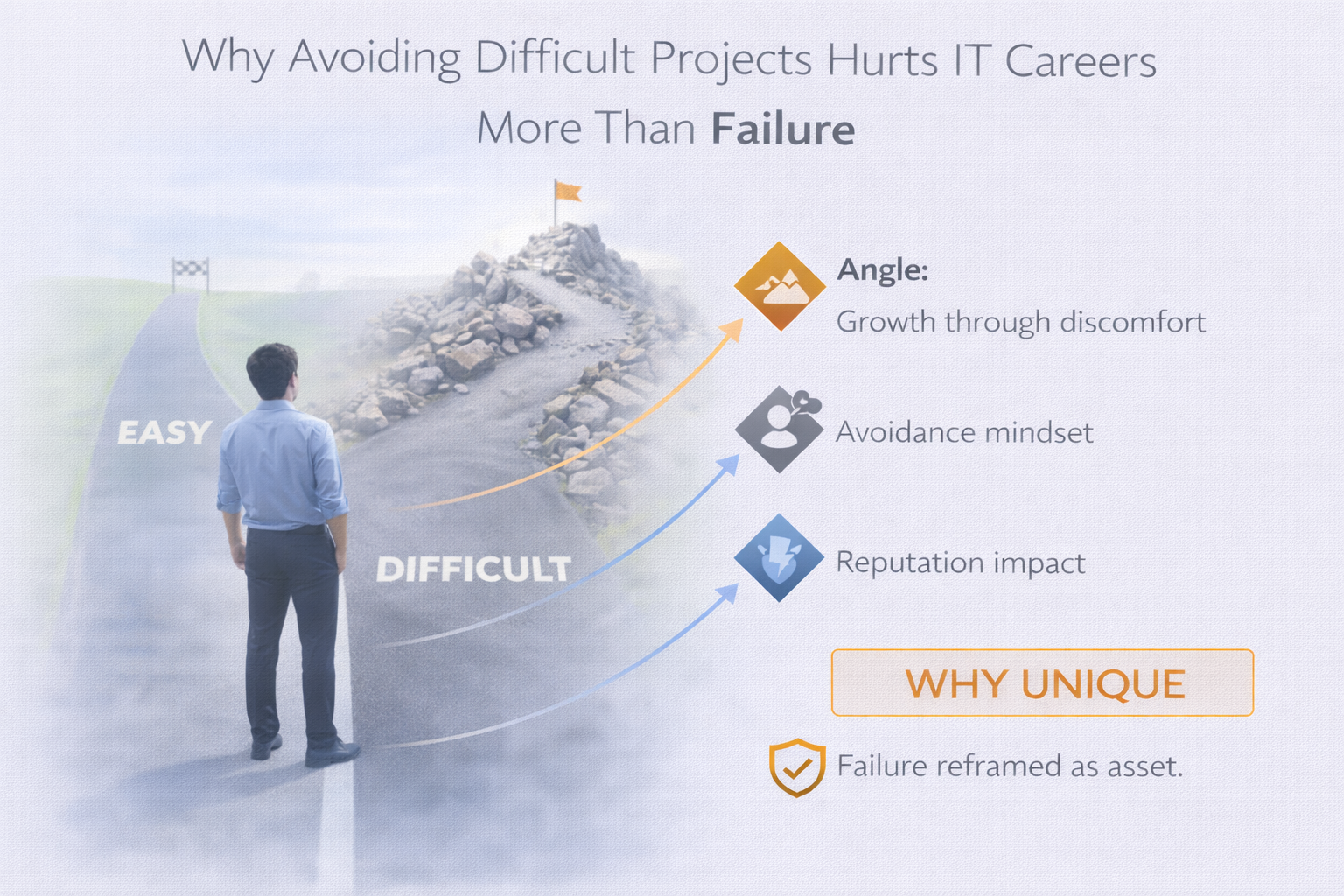
Why Avoiding Difficult Projects Hurts IT Careers More Than Failure
In IT careers, failure is often treated as the ultimate risk. Many professionals structure their choices around avoiding visible mistakes, choosing safe tasks, stable projects, and predictable outcomes.
Ironically, avoiding difficult projects damages IT careers far more than failure ever does.
This blog reframes failure as a long-term asset and explains how growth through discomfort, avoidance mindsets, and reputation dynamics shape career trajectories in technology.
Growth Through Discomfort: Where Capability Is Built
Difficult projects share uncomfortable traits:
- Ambiguous requirements
- High technical or business risk
- Cross-team dependencies
- Public visibility if things go wrong
These conditions are exactly where professional growth accelerates.
Discomfort forces:
- Better decision-making
- Faster learning
- Stronger system thinking
- Ownership beyond task execution
Failure in these environments still produces growth. Avoidance produces none.
The Avoidance Mindset: A Silent Career Limiter
Avoidance is rarely explicit.
It shows up as:
- “This isn’t my responsibility”
- “Let someone more senior handle it”
- “I’ll wait until things are clearer”
- Repeated preference for low-risk work
Over time, teams notice patterns.
Professionals who avoid difficulty are seen as reliable executors — but not as owners, leaders, or problem solvers under pressure.
That perception quietly limits future opportunities.
Reputation Impact: Failure vs Avoidance
Failure and avoidance create very different reputations.
Failure communicates:
- Willingness to take responsibility
- Exposure to complexity
- Learning under pressure
Avoidance communicates:
- Risk aversion
- Limited range
- Dependence on safe conditions
Organizations forgive failure far more easily than they reward avoidance.
People who try and stumble are remembered. People who never step in are bypassed.
Why Failure Becomes an Asset Over Time
Failures that occur during difficult projects:
- Increase credibility when lessons are applied
- Signal courage and ownership
- Build trust through transparency
- Strengthen judgment for future decisions
Avoidance, on the other hand, leaves no learning trail.
Over years, careers shaped by avoidance grow fragile — while careers shaped by failure grow resilient.
Final Insight
Failure may slow you temporarily.
Avoidance slows you permanently.
IT careers grow strongest when professionals choose difficulty, accept discomfort, and treat failure as feedback — not a verdict.
The real career risk is not failing at hard things. It is never being associated with them at all.