For most freshers entering the IT industry, the first instinct is simple:
“Say yes to everything. Don’t refuse. Prove yourself.”
It sounds like the safest strategy—but in reality, it often becomes one of the biggest IT fresher mistakes at work.
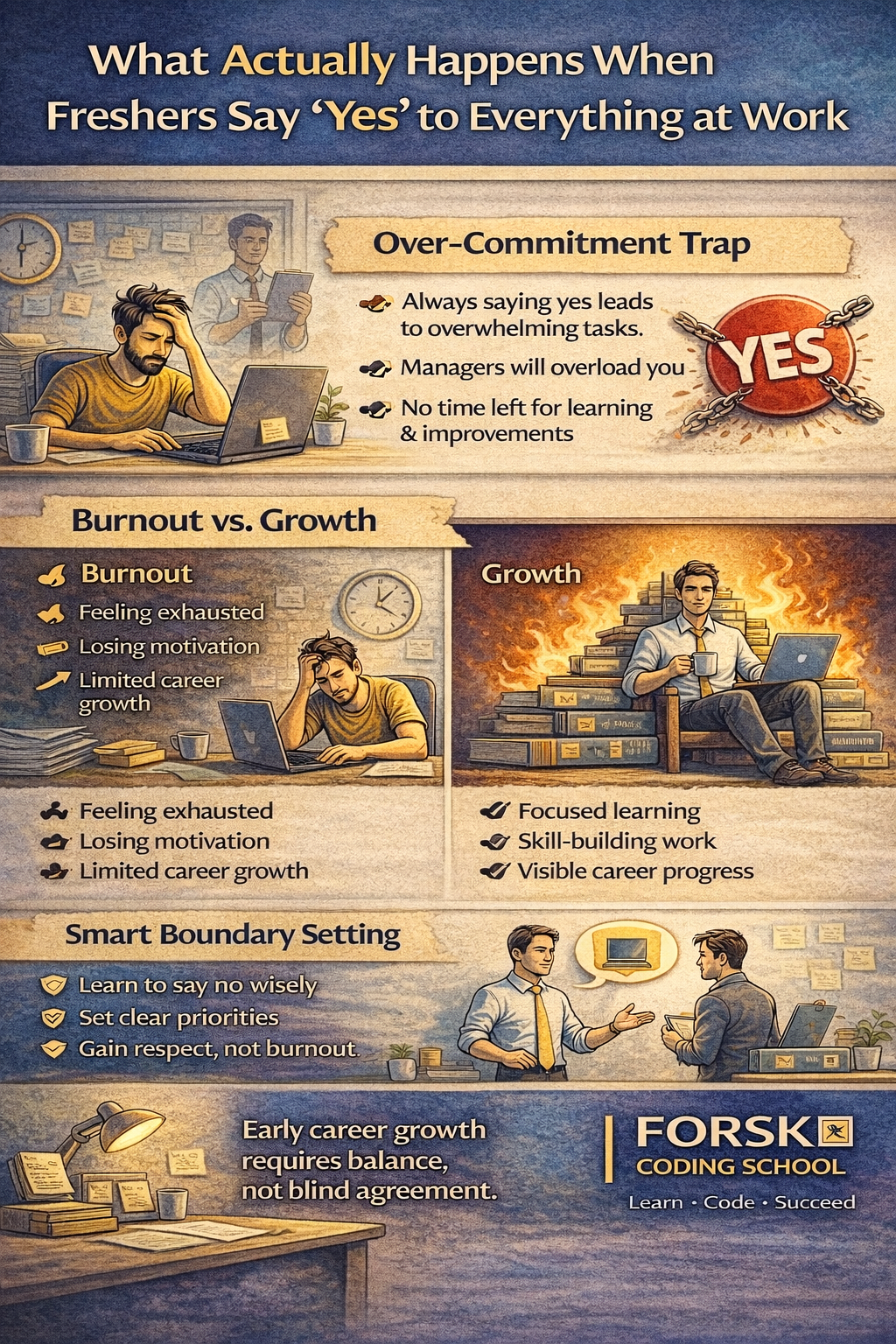
This blog explores what really happens when freshers keep saying yes at the job, how over-commitment turns into burnout instead of growth, and why smart boundary setting is essential for long-term success. This is a post-joining survival topic—not college advice.
Why Freshers Say “Yes” to Everything
Most freshers don’t overcommit because they’re careless. They do it because of:
- Fear of losing the job
- Desire to impress managers
- Lack of clarity about expectations
- Belief that saying no = poor attitude
Early career anxiety drives compliance.
The Over-Commitment Trap
At first, saying yes feels rewarding:
- You look enthusiastic
- Managers notice availability
- Work keeps flowing your way
But soon, the trap reveals itself.
Over-commitment leads to:
- Unrealistic deadlines
- Context switching
- Shallow learning
- Constant pressure
Instead of growth, you get exhaustion.
Burnout vs Growth: Where the Line Breaks
Growth comes from:
- Learning deeply
- Delivering quality
- Understanding systems
Burnout comes from:
- Too many tasks
- No prioritization
- Zero recovery time
Freshers who say yes to everything often:
- Stay busy
- Learn slowly
- Make more mistakes
They confuse exposure with progress.
How Managers Interpret Constant “Yes”
Here’s the surprising part.
Managers don’t always see constant yes as commitment.
They often see:
- Poor estimation skills
- Lack of planning
- Inability to prioritize
- Risk of failure
Reliability matters more than availability.
Why Saying “Yes” Can Stall Your Career
Freshers stuck in the yes-cycle usually:
- Get more work, not better work
- Become task executors
- Miss chances to build expertise
They stay useful, but not valuable.
This is a subtle but dangerous career stall.
Smart Boundary Setting (Not Saying No Blindly)
Setting boundaries doesn’t mean refusal.
It means:
- Asking for priorities
- Clarifying deadlines
- Negotiating scope
- Communicating capacity
Example:
“I can take this up, but it may impact the current task deadline. Which should I prioritize?”
This shows responsibility, not resistance.
How Smart Freshers Actually Grow Faster
Freshers who grow sustainably:
- Commit realistically
- Deliver consistently
- Communicate clearly
- Protect learning time
They don’t say yes to everything.
They say yes to the right things.
Final Thoughts: Growth Needs Judgment, Not Just Effort
Early in your career, effort is important—but judgment is critical.
If you keep saying yes at work without thinking:
- Burnout comes early
- Learning slows down
- Confidence drops
The goal isn’t to impress today.
It’s to last and grow tomorrow.
Key Takeaway
In IT careers:
- Over-commitment leads to burnout
- Smart boundaries lead to growth
Saying yes should be a decision—not a reflex.