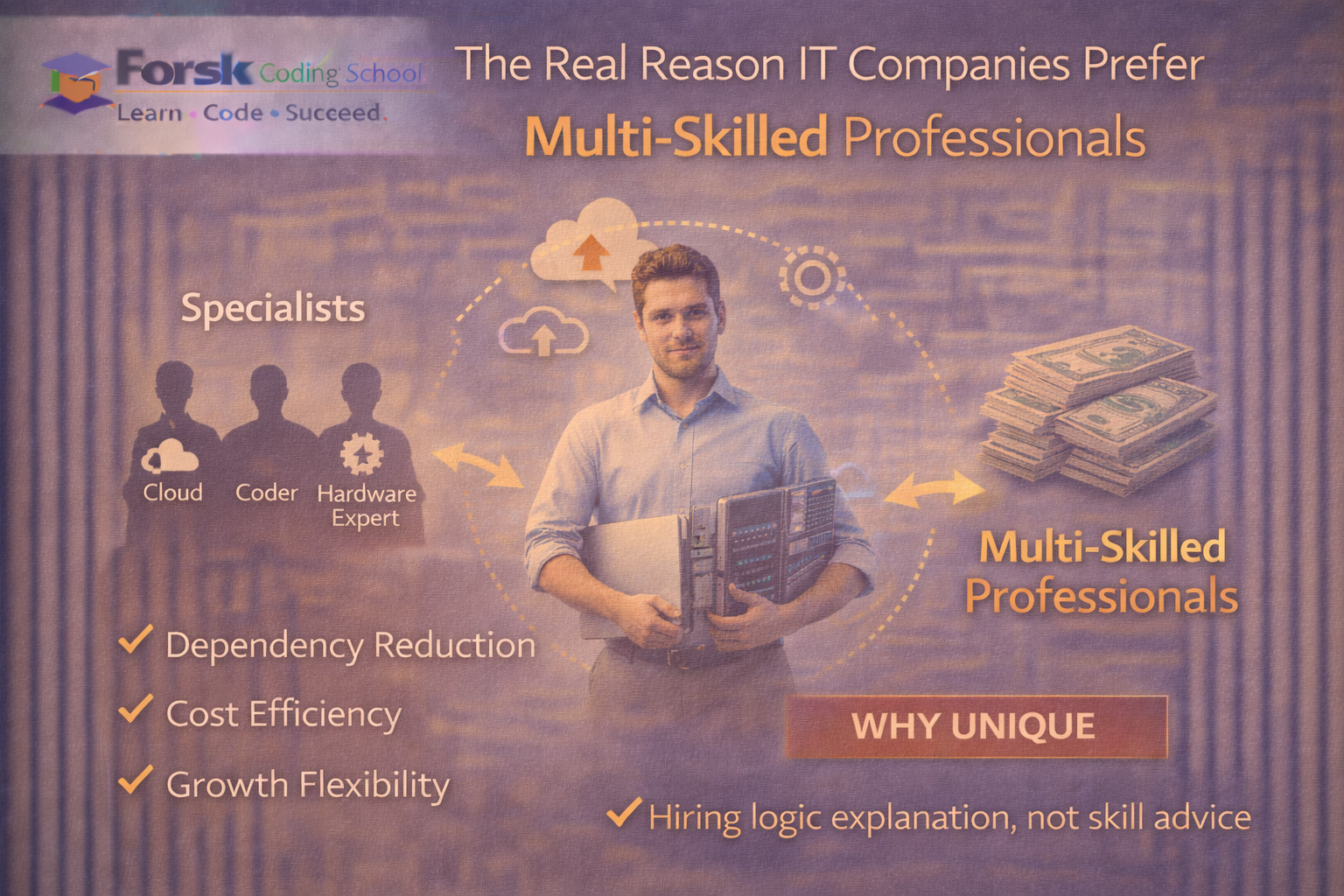
Many IT professionals believe companies prefer multi-skilled candidates because they are “smarter” or “more talented.” In reality, the preference has little to do with intelligence and much more to do with how companies manage risk, cost, and growth. Understanding this hiring logic removes confusion and helps professionals see the system from the company’s perspective.
This is not skill advice. It is a business explanation.
Dependency Reduction Is the Primary Driver
IT companies operate under constant delivery pressure. When work depends heavily on one person or one narrow skill, risk increases. Leaves, resignations, delays, or failures can block entire projects.
Multi-skilled professionals reduce dependency. They:
- Handle overlapping responsibilities
- Step in during gaps
- Understand upstream and downstream impact
From a company’s view, this creates operational stability—not just flexibility.
Cost Efficiency Without Headcount Explosion
Hiring specialists for every task increases cost rapidly. Salaries, onboarding time, and coordination overhead all add up.
Multi-skilled professionals allow companies to:
- Keep teams lean
- Reduce handoff delays
- Maximize output per hire
This does not mean companies want one person to do everything. It means they value people who can cover adjacent responsibilities without friction.
Growth Flexibility in Changing Environments
Business priorities change faster than job descriptions. New clients, new products, new technologies, and new timelines demand adaptability.
Multi-skilled professionals help companies:
- Reassign work quickly
- Scale teams without restructuring
- Experiment without hiring delays
This flexibility is especially critical in service companies and startups, where change is constant.
Why Specialists Still Matter
This does not mean specialists are unimportant. Deep expertise is essential in many roles. However, specialists who understand surrounding systems are far more valuable than isolated experts.
Companies prefer professionals who combine depth with range, not surface-level generalists.
Why Professionals Misinterpret This Preference
Many professionals assume multi-skilling is about working harder or doing unpaid extra work. In reality, it is about reducing organizational friction.
Companies reward those who make systems smoother, not those who create bottlenecks—even unintentionally.
Long-Term Career Impact
Professionals who develop adjacent skills:
- Gain broader context
- Become harder to replace
- Are trusted earlier with responsibility
This trust often leads to leadership paths—not because of skill count, but because of reliability.
Final Thought
IT companies prefer multi-skilled professionals not for heroics, but for stability, efficiency, and growth flexibility. When professionals understand this logic, they stop seeing multi-skilling as exploitation and start seeing it as a strategic career advantage. Understanding hiring logic turns confusion into clarity.