Choosing the right database is a critical decision in software development, data engineering, and backend architecture. One of the most common questions students and developers ask is:
What is the difference between SQL and NoSQL databases?
At Forsk Coding School, we explain this concept in a simple, practical, and industry-oriented way. This guide will help you clearly understand SQL vs NoSQL databases, their structure, use cases, advantages, limitations, and real-world examples.
What Is an SQL Database?
SQL databases are categorized as Relational Database Management Systems (RDBMS). They store data in a structured format using tables with rows and columns.
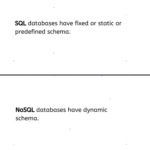
Each table has a fixed or predefined schema, meaning the structure must be decided before inserting data.
Key Characteristics of SQL Databases
- Relational database system (RDBMS)
- Fixed / static schema
- Table-based data storage
- Strong consistency
- Best suited for complex queries
- Uses Structured Query Language (SQL)
SQL databases are ideal when data integrity, accuracy, and complex relationships are important.
What Is a NoSQL Database?
NoSQL databases are categorized as non-relational or distributed database systems. They are designed to handle large-scale, unstructured, and rapidly changing data.
NoSQL databases use a dynamic schema, which means data structure can change without downtime.
Key Characteristics of NoSQL Databases
- Non-relational or distributed system
- Dynamic schema
- Flexible data models
- Horizontally scalable
- High performance for large data volumes
- Queries vary from database to database
NoSQL databases are ideal for big data, real-time applications, and hierarchical data storage.
Schema: SQL vs NoSQL
- SQL databases have a fixed or predefined schema, which ensures data consistency but reduces flexibility.
- NoSQL databases have a dynamic schema, allowing easy changes and faster development.
Data Storage Model
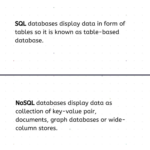
- SQL databases store data in tables, making them table-based databases.
- NoSQL databases store data as:
- Key-value pairs
- Documents
- Graphs
- Wide-column stores
This flexibility allows NoSQL databases to handle complex, nested, and hierarchical data efficiently.
Query Language Difference
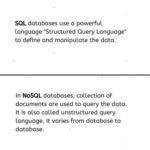
- SQL databases use Structured Query Language (SQL), which is powerful and standardized for defining, querying, and manipulating data.
- NoSQL databases use unstructured or semi-structured query methods, which differ from one database to another.
Performance & Query Complexity
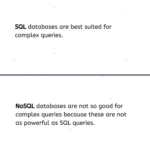
- SQL databases are best suited for complex queries, joins, and multi-table operations.
- NoSQL databases are not ideal for complex relational queries, but they excel in speed and scalability for simple operations.
Hierarchical Data Handling
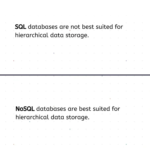
- SQL databases are not best suited for hierarchical data storage.
- NoSQL databases are best suited for hierarchical and nested data, such as JSON-based documents.
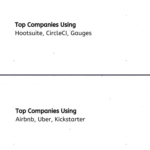
Top Companies Using SQL Databases
Many companies rely on SQL databases for structured and transactional data:
- Hootsuite
- CircleCI
- Gauges
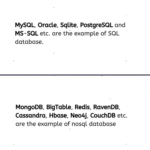
Popular SQL Database Examples
- MySQL
- Oracle
- SQLite
- PostgreSQL
- MS-SQL Server
Top Companies Using NoSQL Databases
NoSQL databases are widely used by companies handling large-scale, real-time data:
- Airbnb
- Uber
- Kickstarter
Popular NoSQL Database Examples
- MongoDB
- BigTable
- Redis
- RavenDB
- Cassandra
- HBase
- Neo4j
- CouchDB
When to Choose SQL vs NoSQL?
Choose SQL When:
- Data is structured and relational
- Complex queries are required
- Strong consistency is important
- Financial or transactional systems are involved
Choose NoSQL When:
- Data is unstructured or semi-structured
- High scalability is required
- Real-time applications are involved
- Hierarchical or big data storage is needed
Why Database Knowledge Matters for Your Career
Understanding SQL vs NoSQL databases is essential for:
- Backend developers
- Full-stack developers
- Data analysts
- Data engineers
- Software architects