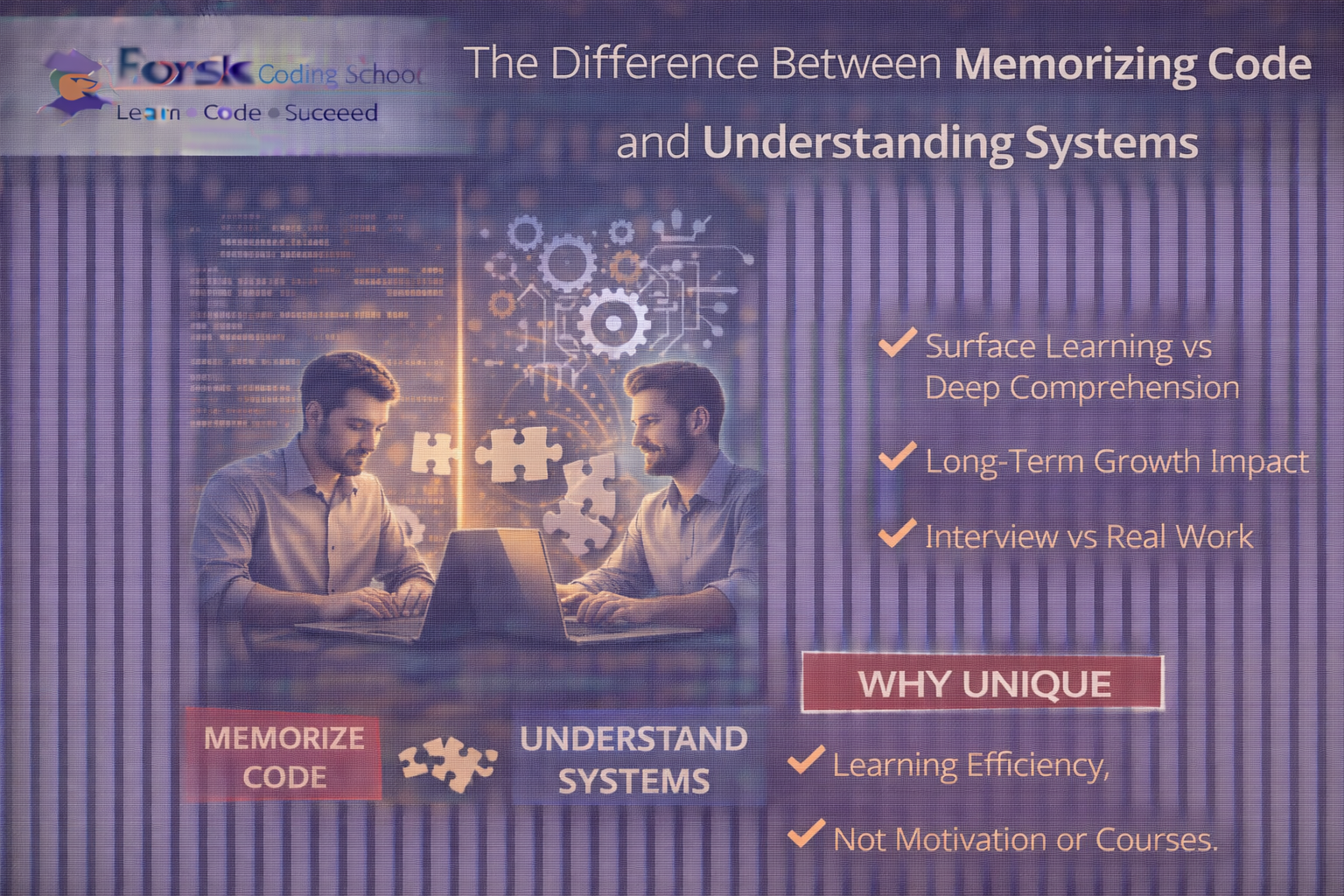
In IT careers, many professionals appear productive on the surface. They remember syntax, recall interview answers, and quickly reproduce solutions from memory. Yet, when faced with real-world systems, unexpected bugs, or architectural decisions, the gap becomes obvious.
The true difference is not skill level—it is how learning happens. Memorizing code and understanding systems are two very different cognitive approaches, and only one leads to long-term growth.
This blog explains why surface learning fails, why deep system understanding matters, and how this difference impacts interviews, real work, and career progression.
Memorizing Code: Surface-Level Learning
Memorizing code focuses on recall rather than comprehension. It often develops through:
- Repeating syntax without context
- Copying solutions from tutorials or GitHub
- Preparing interview answers mechanically
This approach may help in:
- Clearing basic interviews
- Writing familiar programs quickly
- Feeling confident during structured tasks
However, it collapses when:
- Requirements change
- Systems scale
- Errors behave unpredictably
Memory-based learning does not build adaptability.
Understanding Systems: Deep Comprehension
Understanding systems means knowing how and why components interact.
System thinkers:
- Understand data flow, not just functions
- See cause-and-effect relationships
- Predict behavior under load or failure
Instead of asking:
“What code should I write?”
They ask:
“How will this affect the system as a whole?”
This mindset leads to confidence in unfamiliar problems and faster learning across technologies.
Interview Performance vs Real-World Work
Many IT professionals experience a shock after joining a company.
Why?
Interviews often reward:
- Remembered answers
- Known patterns
- Controlled scenarios
Real work demands:
- Debugging incomplete information
- Understanding legacy systems
- Making trade-offs
Those who memorized code struggle to move beyond assigned tasks. Those who understand systems grow into ownership roles.
Long-Term Career Impact
Memorization creates short-term speed. System understanding creates long-term momentum.
Professionals with system thinking:
- Adapt faster to new stacks
- Design scalable solutions
- Communicate clearly with architects and stakeholders
Over time, they transition from implementers to decision-makers.
Why This Difference Is Rarely Taught
Most courses teach what to write, not how systems behave.
System understanding develops through:
- Breaking things intentionally
- Observing failures
- Asking structural questions
This cognitive depth cannot be rushed or memorized—it must be built.
How to Shift from Memorizing to Understanding
To build system-level thinking:
- Trace data from input to output
- Ask why a design exists
- Study failures, not just success cases
- Rebuild simple systems from scratch
This approach rewires how you learn—not just what you learn.
Final Thoughts
The difference between memorizing code and understanding systems defines how far an IT career can go.
Code changes. Systems thinking compounds.
If you want sustainable growth, stop learning code in isolation. Start learning how systems actually work together.