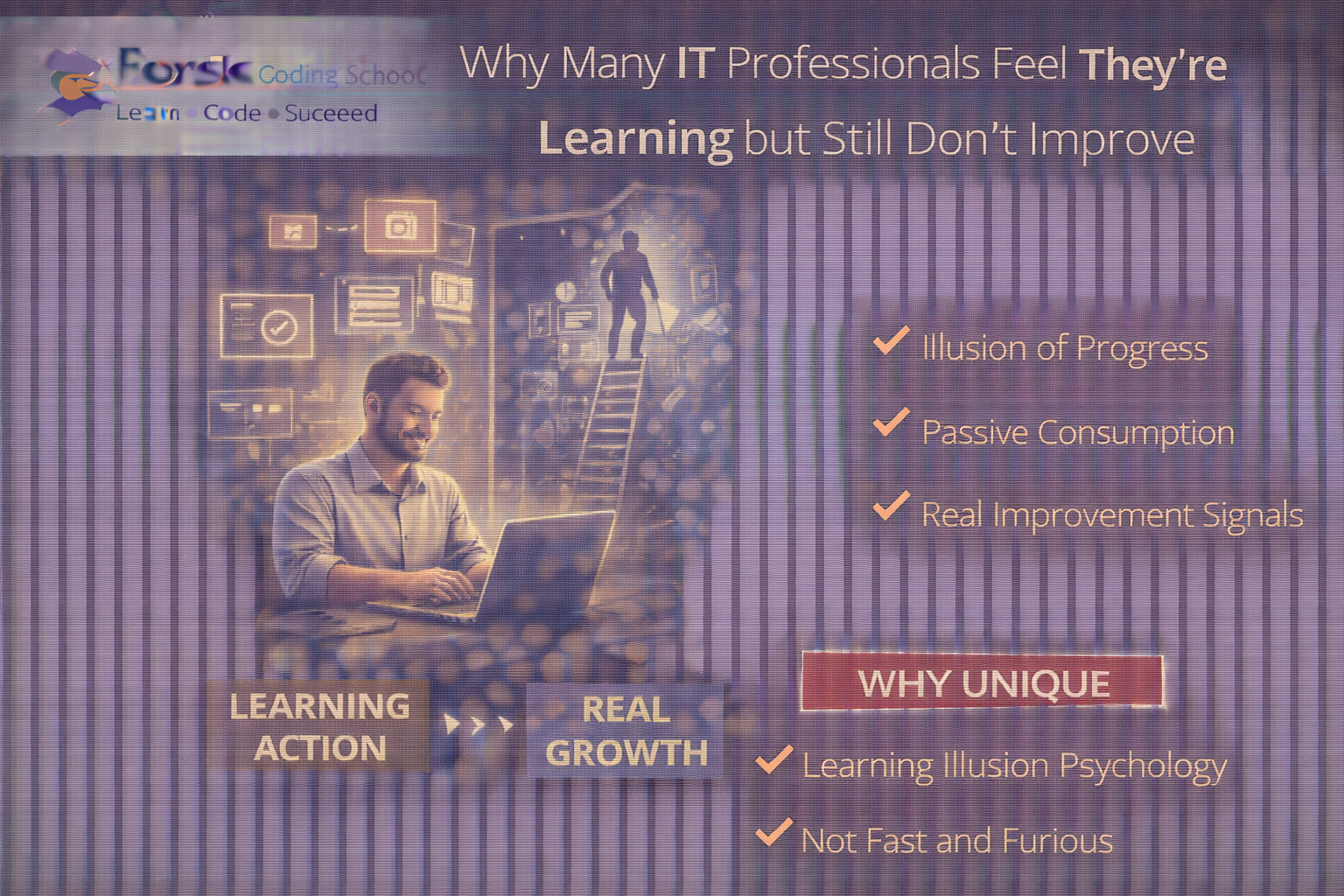
Many IT professionals are constantly learning. They watch tutorials, read blogs, follow influencers, complete courses, and stay updated with trends. Yet despite consistent effort, a frustrating feeling remains—nothing is really improving.
This gap between effort and outcome is not imaginary. It is driven by the illusion of progress—a psychological effect where learning activity is mistaken for learning impact.
This blog explains why passive consumption creates false signals, how learning illusion forms, and what real improvement actually looks like in IT careers.
The Illusion of Progress in IT Learning
The brain rewards exposure with a sense of familiarity.
When professionals:
- Recognize terms
- Recall examples
- Follow explanations smoothly
The mind interprets this as understanding—even when no skill has changed.
This illusion feels productive but does not translate into better problem-solving, design ability, or confidence under pressure.
Passive Consumption vs Active Learning
Passive learning dominates modern IT education.
Examples include:
- Watching tutorials without pausing
- Reading articles without applying ideas
- Skimming documentation for reassurance
Passive consumption creates comfort, not capability.
Active learning, by contrast, requires:
- Making decisions
- Testing assumptions
- Facing failure signals
Only active engagement rewires skill.
Why Effort Alone Doesn’t Equal Improvement
Many professionals work hard but improve slowly because effort is misdirected.
Effort spent on:
- Consuming more content
- Switching topics frequently
- Avoiding difficult problems
Creates motion without progress.
Improvement requires resistance—moments where understanding breaks and must be rebuilt.
Real Improvement Signals Most People Ignore
True learning produces discomfort.
Real signals include:
- Being able to explain concepts simply
- Making fewer repeated mistakes
- Handling unfamiliar problems with structure
- Needing less external reference
These changes are subtle and slow—but durable.
Why Learning Illusion Is Hard to Detect
Learning illusion persists because:
- Activity feels productive
- Progress is hard to measure
- External validation is absent
Without feedback or challenge, the brain assumes growth.
How to Break the Learning Illusion
To escape false progress:
- Replace watching with building
- Test understanding without notes
- Solve problems before seeing solutions
- Reflect on what actually changed
Learning becomes real when assumptions are challenged.
Final Thoughts
Many IT professionals feel they’re learning but still don’t improve because learning illusion replaces real skill development.
Growth does not come from consuming more—it comes from confronting gaps.
In IT, improvement begins when learning stops feeling comfortable.