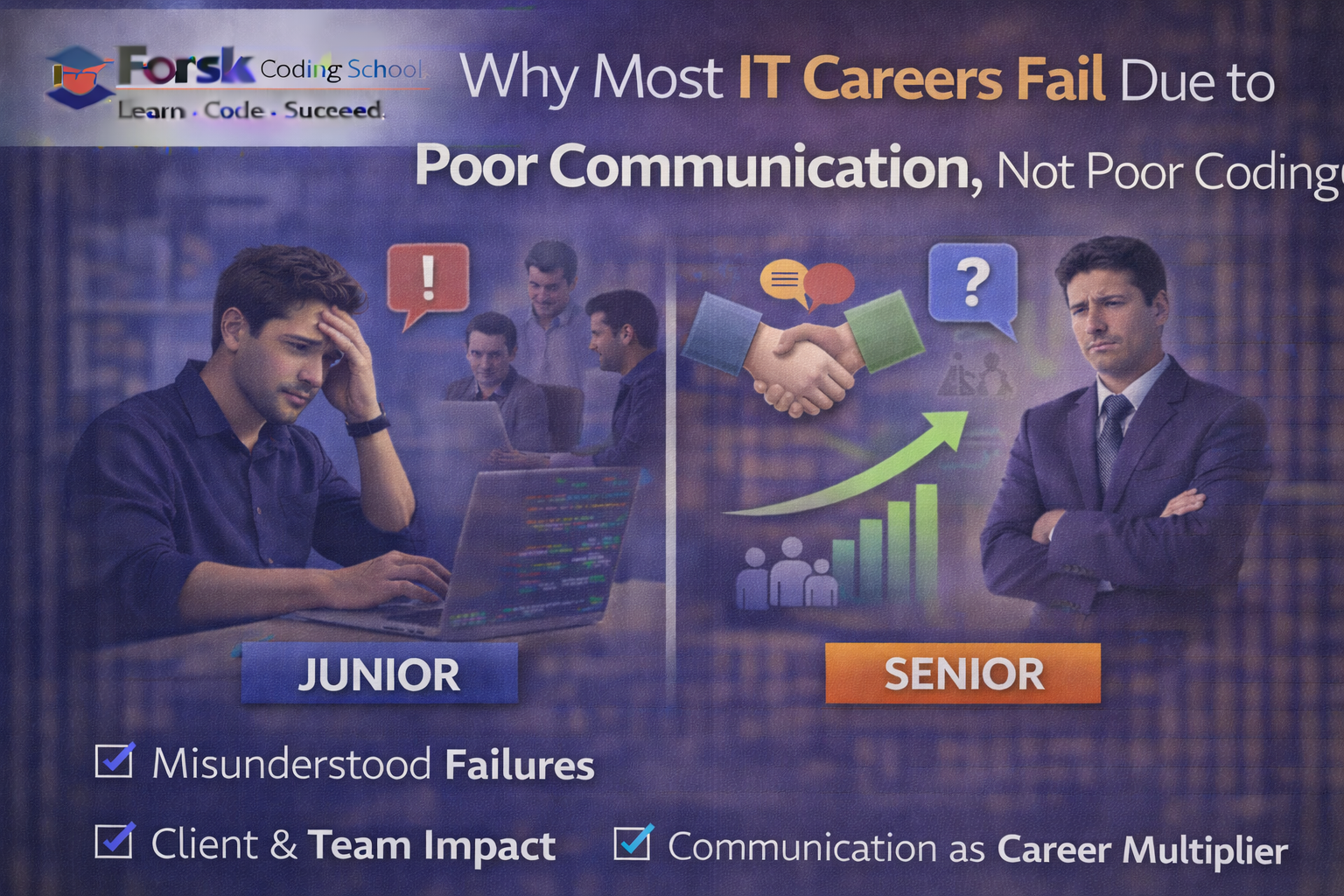
When IT careers struggle or stall, coding ability is often blamed. People assume the professional wasn’t technically strong enough. But in reality, most IT career failures have very little to do with poor coding.
They happen because of poor communication.
This truth is important not just for IT professionals—but also for parents trying to understand why capable engineers sometimes face career setbacks. This blog explains how misunderstood failures occur, how communication affects teams and clients, and why communication is one of the biggest career multipliers in IT.
The Biggest Misunderstanding About IT Failures
Many people believe:
- “If someone is good at coding, they will succeed in IT.”
But real-world IT careers don’t work that way.
In professional environments, success depends on:
- Explaining ideas clearly
- Understanding requirements
- Aligning with teams and clients
A technically correct solution that is misunderstood can still fail.
How Poor Communication Breaks IT Careers
1. Misunderstood Requirements
Many project issues begin not with bad code, but with unclear understanding:
- What does the client actually want?
- What problem are we solving?
When communication is weak, engineers build the wrong solution—even if it’s technically perfect.
2. Team-Level Conflicts
IT work is rarely solo. Poor communication leads to:
- Assumptions instead of clarity
- Friction between developers, testers, and managers
- Blame when things go wrong
Over time, capable professionals get labeled as “difficult” or “unreliable.”
3. Invisibility of Good Work
Many skilled engineers fail to:
- Explain what they’ve done
- Share progress clearly
- Highlight risks early
As a result, their contributions go unnoticed—even when they work hard.
Client Impact: Where Careers Are Really Judged
Clients rarely judge code quality directly.
They judge:
- Clarity of explanations
- Responsiveness
- Confidence and trust
Engineers who communicate well:
- Build client confidence
- Handle scope changes better
- Protect projects from escalation
This directly affects career growth.
Communication Is a Career Multiplier
Same Skill, Different Outcomes
Two engineers with similar coding skills can have very different careers.
The difference is often:
- Who explains problems better
- Who asks the right questions
- Who communicates risks early
Communication multiplies the value of technical skill.
Why Many IT Professionals Ignore Communication
Common reasons include:
- Belief that “coding should speak for itself”
- Fear of speaking up
- Overfocus on technical learning
Unfortunately, silence is often mistaken for lack of competence.
Why Parents Should Understand This Reality
Parents often worry:
- “My child knows coding, why are they struggling?”
The answer is usually not intelligence—it’s exposure, confidence, and communication.
Encouraging communication skills is just as important as technical learning.
How IT Professionals Can Improve Communication
Good communication does not mean perfect English. It means:
- Asking clear questions
- Explaining thought process
- Sharing concerns early
- Listening actively
These skills can be learned and practiced.
Final Takeaway
Most IT careers don’t fail because professionals can’t code.
They fail because ideas, expectations, and concerns are not communicated clearly.
In the IT industry, coding gets you entry.
Communication determines how far you go.
A successful IT career is built as much on clarity as it is on code.