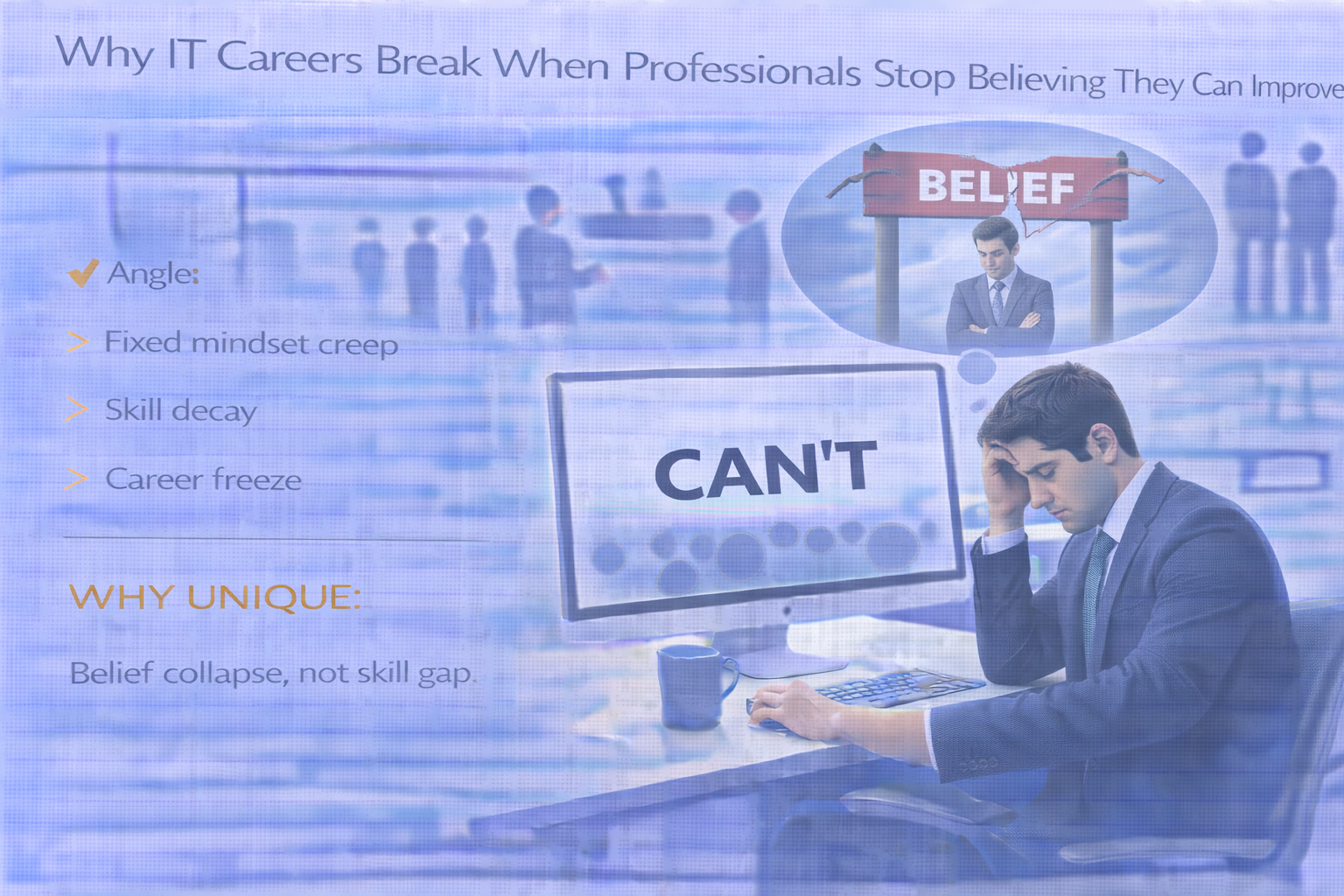
In IT careers, skill gaps are often blamed for stagnation. But many careers don’t break because professionals can’t learn—they break because professionals stop believing they can improve.
This loss of belief quietly triggers fixed mindset creep, skill decay, and eventual career freeze. The real issue isn’t ability—it’s belief collapse.
Fixed Mindset Creep: When Growth Stops Feeling Possible
Fixed mindset creep doesn’t happen overnight. It develops slowly through thoughts like:
- “I’m not good at learning new tech anymore”
- “This is probably my limit”
- “Younger engineers pick this up faster”
Over time, learning feels harder—not because it is, but because belief in improvement weakens. Challenges begin to feel threatening instead of developmental.
Skill Decay: What Happens When Belief Drops
When professionals stop believing they can improve, behavior changes:
- Learning becomes passive
- Practice becomes inconsistent
- Curiosity fades
- New tools feel overwhelming
Skills don’t disappear instantly—they decay slowly. The decline is subtle but cumulative, creating the illusion that one is “falling behind.”
Career Freeze: Staying Busy Without Progress
Career freeze occurs when professionals remain active but stop evolving.
Signs include:
- Staying in the same role for years
- Avoiding new responsibilities
- Repeating familiar tasks
- Feeling stuck despite experience
At this stage, careers feel heavy and directionless. The freeze is not caused by lack of opportunity, but by disengagement from growth.
Why This Is Belief Collapse, Not Skill Gap
Skill gaps can be closed. Belief collapse shuts the door before learning begins.
Once professionals believe improvement is no longer possible:
- Effort feels pointless
- Feedback feels personal
- Growth feels unrealistic
This mindset quietly ends careers long before titles or pay change.
Rebuilding the Belief in Improvement
Career recovery begins with restoring belief:
- Break learning into small, achievable wins
- Update self-perception based on recent progress
- Learn alongside peers instead of in isolation
- Treat confusion as a signal of growth, not decline
Belief returns through evidence—not motivation.
Final Thoughts
IT careers don’t break when skills become outdated—they break when professionals stop believing they can grow.
The most dangerous moment in an IT career isn’t falling behind—it’s deciding improvement is no longer possible.
Growth resumes the moment belief is restored.