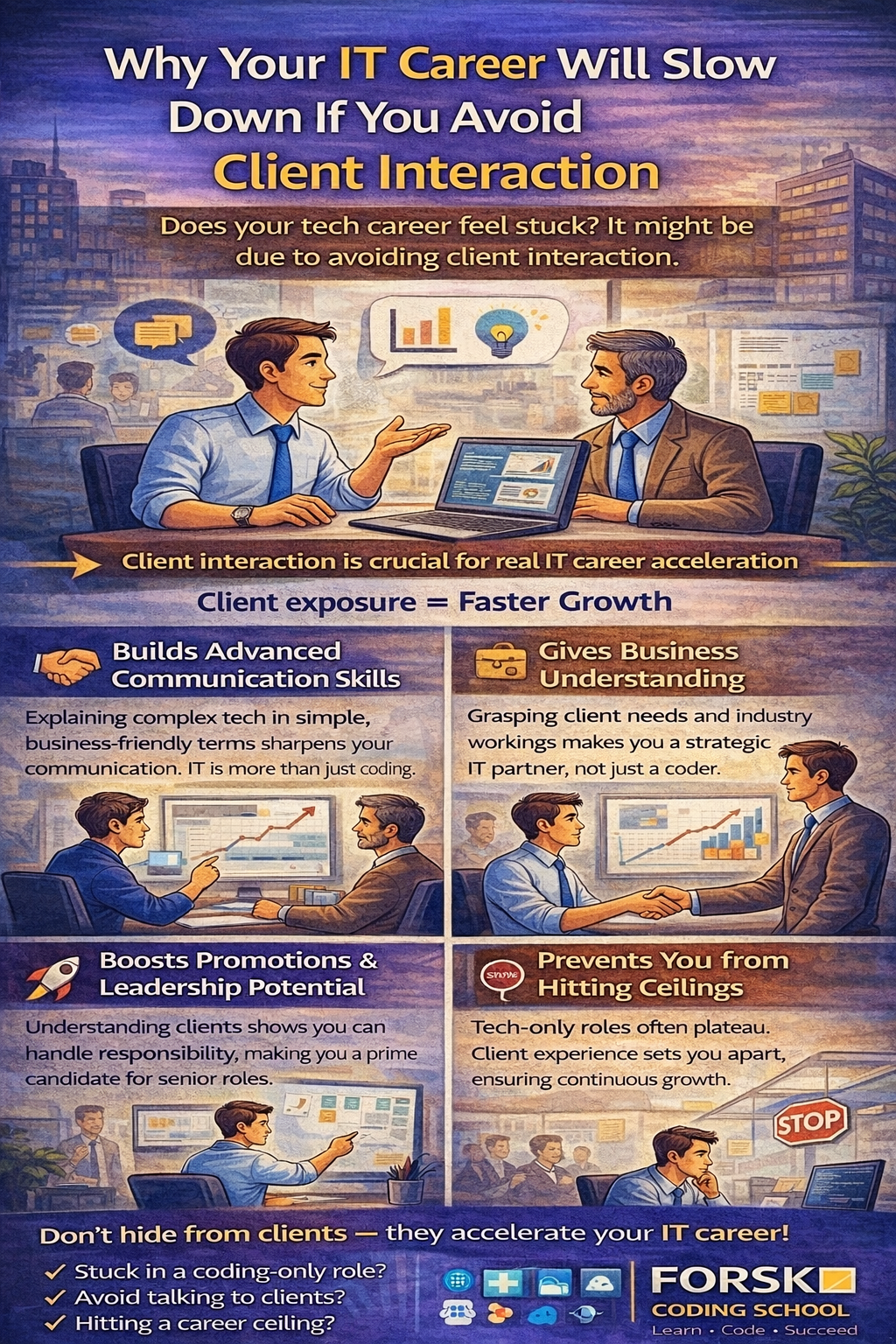
Many IT professionals believe that staying purely technical is the safest and fastest way to grow. They think: “I’ll just focus on coding, tools, and frameworks—client interaction is not my job.” In the early years, this approach may seem comfortable. But over time, it becomes one of the biggest reasons IT careers slow down or completely plateau.
Client interaction is not a distraction from technical growth—it is a career acceleration factor. This blog explains why avoiding clients limits growth, how client exposure changes your value in the IT industry, and why tech-only roles often hit invisible ceilings.
The Hidden Truth About IT Career Growth
In the IT industry, promotions and opportunities are not decided only by how well you write code. They are influenced by:
- How well you understand business problems
- How confidently you communicate solutions
- How much responsibility you can handle beyond tasks
Client interaction sits at the center of all three.
Why Client Interaction Matters in IT Careers
1. Clients Define the Real Problem
Internal tasks are often well-defined. Client problems are not.
When you interact with clients, you learn:
- How requirements are unclear in the real world
- Why features change mid-project
- How business priorities override technical preferences
This exposure teaches problem framing, not just problem solving—a skill senior engineers and architects must have.
2. Communication Turns Developers Into Professionals
Many technically strong engineers struggle to grow because they cannot:
- Explain their work clearly
- Defend technical decisions
- Translate tech language into business language
Client interaction forces you to practice:
- Clear communication
- Listening before solving
- Handling objections and feedback
These skills directly impact leadership and growth.
Why Tech-Only Roles Hit Career Ceilings
1. You Become Replaceable
Pure technical roles focused only on execution are:
- Easy to outsource
- Easy to automate
- Easy to replace
When you avoid client-facing responsibilities, your role stays limited to implementation, not ownership.
2. Promotions Require Trust, Not Just Skill
As you move up:
- Fewer people write code
- More people make decisions
- More people represent the company
Managers promote professionals who can be trusted with clients—not just commits and pull requests.
3. You Miss Business Context
Without client exposure, you don’t learn:
- Why deadlines matter
- How budgets affect decisions
- What success looks like for the client
This gap prevents you from thinking like a senior engineer, consultant, or architect.
Client Interaction Accelerates IT Careers
1. Faster Learning Curve
Client discussions expose you to:
- Multiple industries
- Different use cases
- Real-world constraints
This learning cannot be gained from tutorials or internal tickets alone.
2. Visibility and Recognition
Clients remember people who:
- Solve problems proactively
- Communicate clearly
- Take ownership
This visibility often leads to:
- Better appraisals
- Leadership roles
- Onsite or high-impact opportunities
3. Transition to High-Value Roles
Roles like:
- Solution Architect
- Technical Consultant
- Product Engineer
- Engineering Manager
All require strong client interaction skills. Avoiding clients delays or blocks entry into these roles.
Why Many Engineers Avoid Client Interaction
Common reasons include:
- Fear of communication
- Lack of confidence in English
- Comfort with code over conversation
- Belief that “clients are management’s problem”
Unfortunately, comfort zones slow careers.
How to Start Client Interaction (Even as a Fresher)
You don’t need to lead meetings on day one. Start small:
- Join requirement calls silently
- Observe how seniors speak
- Ask clarifying questions
- Explain small modules
Confidence grows with exposure, not avoidance.
Final Takeaway
If you avoid client interaction, your IT career may start strong—but it will slow down sooner than you expect.
Technical skills get you hired.
Client interaction gets you promoted.
The fastest-growing IT professionals are not the ones who code the most—but the ones who understand problems, communicate solutions, and take ownership.
Don’t run away from clients. Learn from them. Your future roles depend on it.
In IT, growth belongs to those who can connect technology with people.