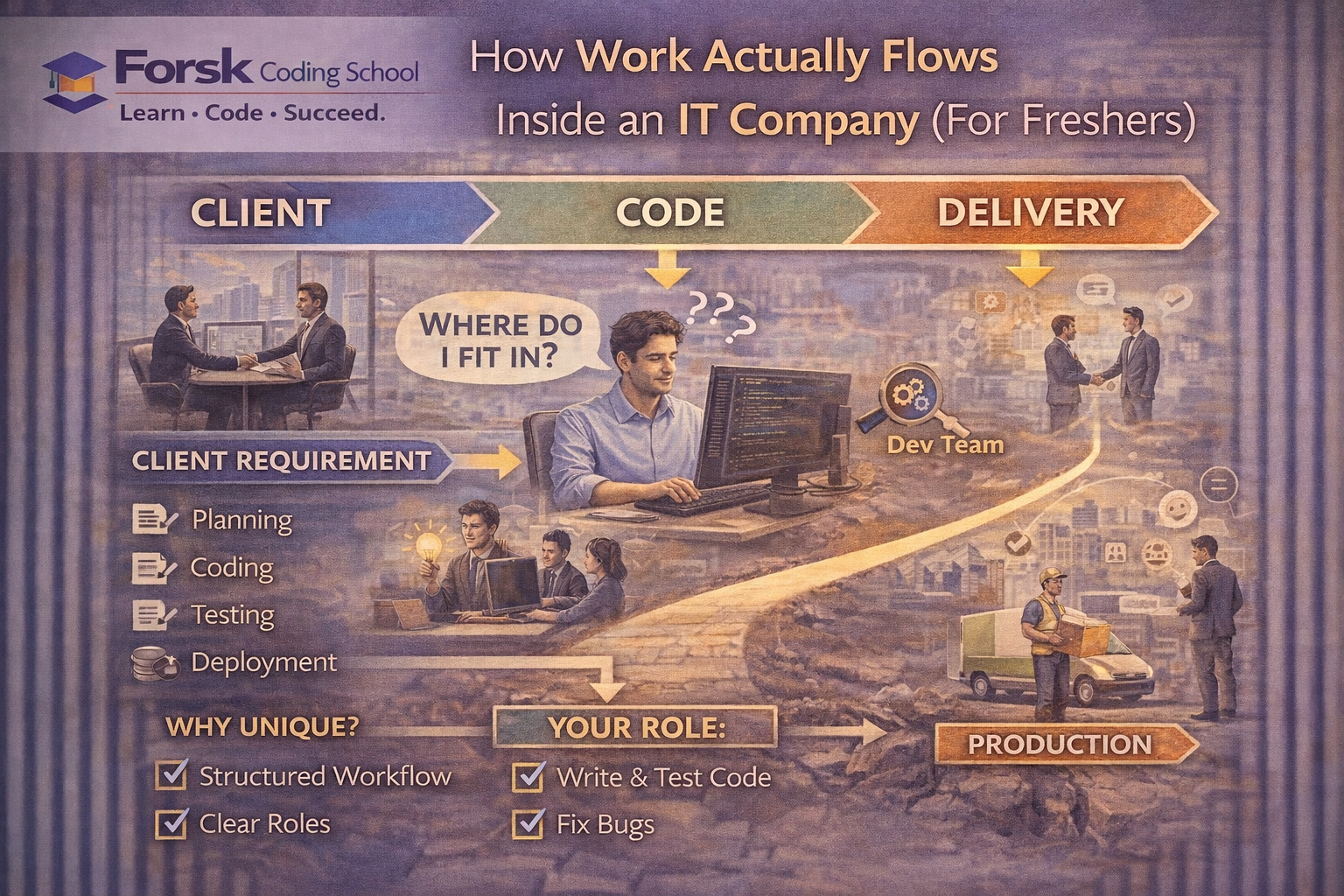
For many freshers, joining an IT company feels overwhelming. You know programming, tools, and concepts—but once inside an organization, things suddenly feel unclear. Meetings, tickets, reviews, timelines, and multiple roles make it hard to understand one basic question: How does work actually move from an idea to delivery?
This confusion is normal. Colleges teach skills, but companies run on systems. Understanding this workflow early is what helps freshers stop feeling lost.
Step 1: Client Requirement – Where Everything Starts
All IT work begins with a business problem. A client may want a website, an app, automation, or a system improvement. These requirements are rarely technical at first. They are expressed in business language—goals, pain points, deadlines, and budgets.
Business analysts, product managers, or senior team members convert these needs into structured requirements. Freshers often do not see this stage clearly, which is why tasks later feel disconnected.
Step 2: Requirement Breakdown & Planning
Once requirements are clear, the work is broken into smaller units:
- Features
- Modules
- Tasks or tickets
Planning includes timelines, priorities, dependencies, and risk assessment. This stage decides what will be built first and what can wait. Freshers usually enter the workflow from here, not from the client side.
Step 3: Design & Technical Decisions
Before coding starts, teams decide how things will be built. This may include:
- System architecture
- Database design
- API structure
- UI/UX flows
These decisions are made to balance performance, scalability, and cost. Freshers often receive tasks without understanding these choices, which makes work feel mechanical instead of meaningful.
Step 4: Development – Where Freshers Mostly Work
This is the most visible stage for freshers. Tasks are assigned through project management tools. Code is written, reviewed, tested, and refined.
At this stage, your role is not just to write code, but to:
- Follow standards
- Communicate blockers
- Understand how your part fits the bigger system
Freshers feel lost when they focus only on their code and not its purpose.
Step 5: Testing, Review & Iteration
After development, code goes through testing and reviews. Bugs are found, feedback is given, and improvements are made. This loop may repeat multiple times.
Many freshers take feedback personally, not realizing that iteration is a core part of professional software development—not a sign of failure.
Step 6: Deployment & Delivery
Once stable, the product is deployed and delivered to the client or end users. This is where business value is finally created. Many freshers never see this stage closely, which is why work can feel endless and unrewarding.
Understanding delivery helps you connect daily tasks to real-world impact.
Why Freshers Feel Lost Initially
Freshers struggle because:
- They see only a small piece of the workflow
- They are not taught how decisions are made
- They confuse task completion with value creation
This confusion fades when the full system becomes clear.
Where Your Role Fits
As a fresher, you are a system component—not the whole system. Growth comes when you:
- Understand upstream (requirements)
- Respect downstream (testing & delivery)
- Improve how reliably your part works
Professionals who understand workflow grow faster than those who only improve syntax.
Final Thought
IT companies do not run on code alone—they run on flow. When freshers understand how work moves from client requirement to delivery, confusion turns into clarity. Master the system early, and your career progression becomes predictable instead of stressful.