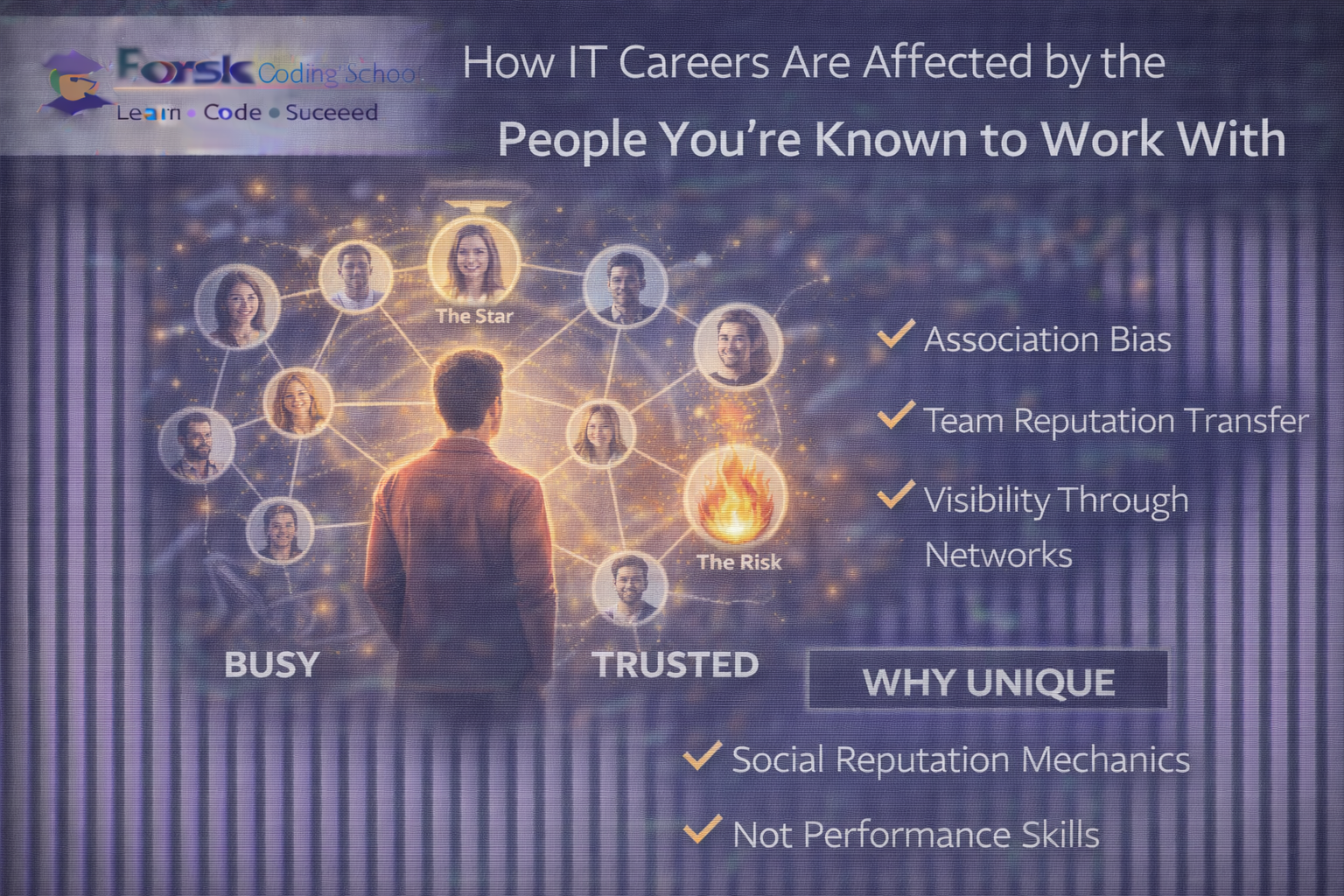
In IT careers, growth is often explained through skills, performance, and individual effort. What is discussed far less—but quietly shapes opportunities—is association. The people you are known to work with influence how others evaluate you long before your resume is read or your work is reviewed.
This is not networking advice. It is social reputation mechanics inside IT organizations.
Association Bias in IT Teams
Association bias is a simple human shortcut: people infer your quality from the company you keep. In IT teams, this happens constantly.
When your name is repeatedly linked with:
- Reliable engineers
- Strong leaders
- High-impact teams
assumptions form automatically. The reverse is also true.
These judgments are rarely conscious—but they are powerful.
Team Reputation Transfers to Individuals
Teams develop reputations over time: strong delivery, poor quality, firefighting, innovation, or stability. Individuals associated with these teams inherit part of that reputation.
Professionals from trusted teams are often assumed to be:
- More dependable
- Better decision-makers
- Lower risk hires
This transfer happens even before individual evaluation begins.
Why Some People Get Visibility Faster
Visibility in IT does not come only from speaking up. It often comes from proximity.
Working with respected people:
- Pulls you into important discussions
- Exposes your work to decision-makers
- Creates second-hand credibility
This visibility feels effortless from the outside, but it is driven by association.
The Hidden Risk of Weak Associations
Working long-term in low-trust environments creates drag:
- Your work gets discounted
- Your growth signals weaken
- External opportunities become harder
This does not mean abandoning teams impulsively—but it does mean understanding the cost of prolonged association.
Choosing Associations Intentionally
Strategic professionals pay attention to:
- Who reviews their work
- Whose projects they join
- Which teams they attach their name to
This is not politics—it is career hygiene.
How Association Shapes External Market Perception
Externally, hiring managers often evaluate based on prior teams and collaborators:
- “They worked with X team—interesting.”
- “They come recommended by Y—trustworthy.”
Association shortens evaluation time and reduces perceived risk.
Final Thought
IT careers are not built in isolation. They are shaped by ecosystems of people, teams, and reputations. The people you are known to work with quietly influence how your capability is interpreted. Understanding association bias allows professionals to make conscious choices—without manipulation. In IT, reputation travels through networks before it travels through resumes.