In IT careers, longevity is often attributed to technical relevance and continuous learning. But many professionals with strong skills still burn out or exit early. What truly sustains long IT careers is not just skill—it is emotional resilience.
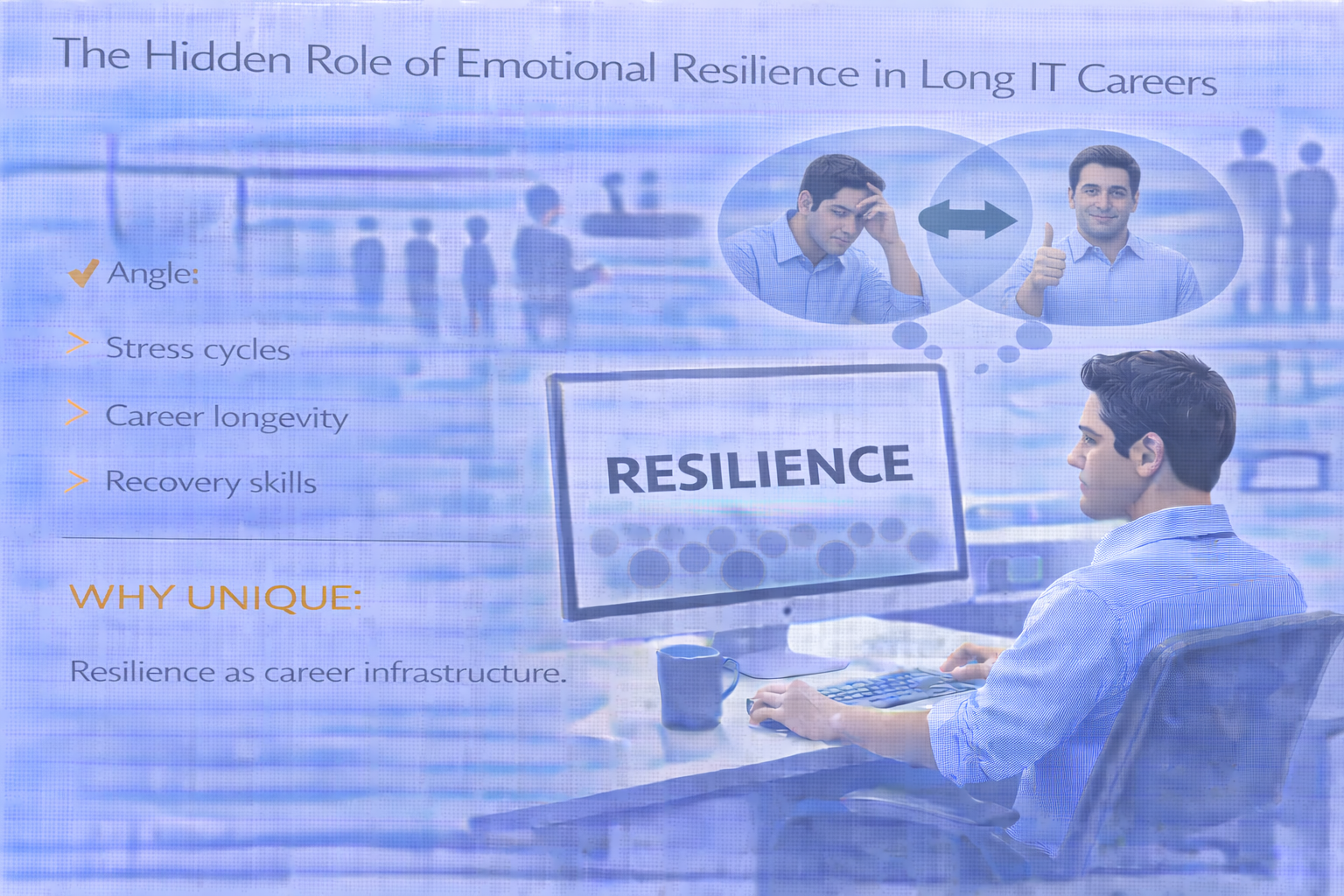
This blog explores how stress cycles shape IT careers, why resilience determines career longevity, and how recovery skills function as invisible career infrastructure.
Stress Cycles: The Reality of Long IT Careers
IT careers are not linear. They move through repeated stress cycles:
- Tight deadlines and releases
- Technology shifts and relearning
- Performance reviews and uncertainty
- High cognitive load for long periods
Stress is unavoidable. What differs is how professionals respond to it. Without resilience, stress accumulates. With resilience, stress becomes cyclical and manageable.
Career Longevity: Why Some Last While Others Burn Out
Two professionals may face the same pressure. One sustains a 15–20 year career, while the other burns out in half the time.
The difference lies in:
- Emotional recovery speed
- Ability to detach from constant urgency
- Maintaining identity beyond work outcomes
Resilient professionals don’t avoid stress—they recover from it efficiently.
Recovery Skills: The Missing Career Skill
Recovery is rarely taught in IT. Yet it is a core professional skill.
Effective recovery skills include:
- Recognizing early burnout signals
- Regulating emotional overload
- Resetting focus after setbacks
- Creating psychological safety outside work
Without recovery skills, even high performers eventually exhaust themselves.
Why Resilience Is Career Infrastructure
Technical skills build what you deliver. Emotional resilience sustains who delivers it.
Resilience:
- Protects long-term performance
- Enables adaptability during change
- Prevents burnout-driven exits
- Supports consistent learning
It operates silently, like infrastructure—noticed only when it breaks.
Building Emotional Resilience in IT Careers
Resilience can be developed:
- Treat stress as a cycle, not a constant
- Normalize recovery, not just effort
- Build routines that restore emotional energy
- Measure success across years, not quarters
Long careers are built through sustainability, not intensity.
Final Thoughts
The hidden role of emotional resilience explains why some IT professionals thrive for decades while others fade early.
Resilience is not a soft skill—it is career infrastructure.
Those who build it don’t just survive long IT careers—they grow steadily within them.