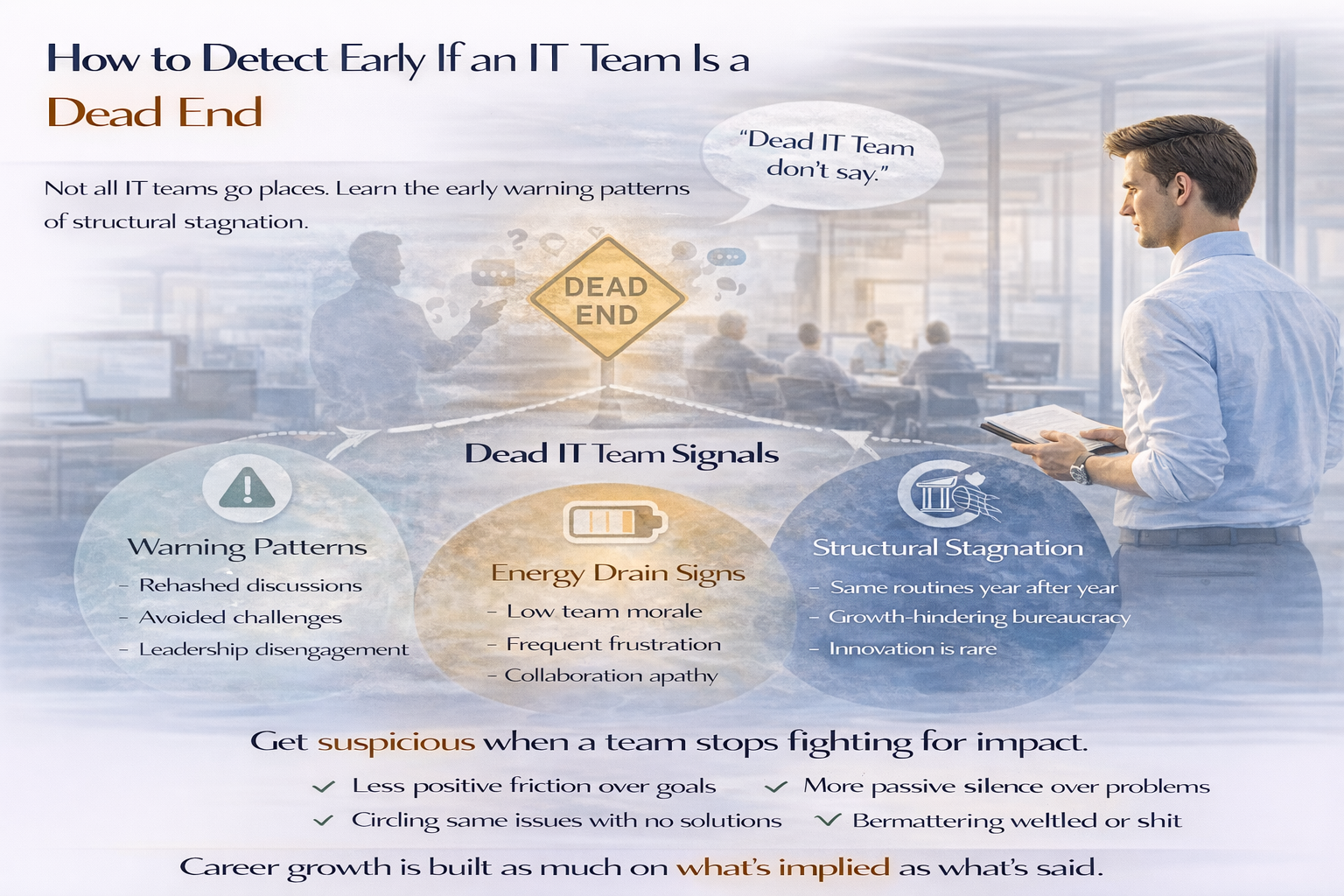
Not all IT teams fail.
Some simply stop leading anywhere.
They don’t collapse.
They don’t create obvious problems.
They quietly drain energy, learning, and momentum.
Professionals who stay too long often realize late that the issue wasn’t personal performance — it was the team trajectory.
Why Dead Ends Are Hard to Recognize
Dead-end teams rarely look bad.
- Work continues
- Deadlines are met
- Stability exists
From the inside, things feel “fine”.
From a career perspective, progress is quietly stalled.
Warning Pattern 1: Energy Drain Without Learning
Hard work is normal.
Hard work without learning is a warning.
Signals include:
- Repeating the same problems
- No new problem types
- No exposure to unfamiliar decisions
When effort doesn’t expand capability, the team may be a dead end.
Warning Pattern 2: Structural Stagnation
Pay attention to structure, not sentiment:
- No meaningful role evolution
- Promotions without responsibility change
- Same people making the same decisions year after year
Structure reveals future paths.
Stagnant structures limit growth regardless of intent.
Warning Pattern 3: Isolation from Influence
Dead-end teams often operate at the edges:
- Minimal interaction with decision-makers
- Work handed down, not discussed
- No visibility during critical moments
Isolation reduces learning, relevance, and opportunity.
Warning Pattern 4: Optimizing for Comfort Over Impact
Comfort signals can be deceptive:
- Predictable work
- Clear boundaries
- Low conflict
But teams that avoid tension often avoid growth.
High-impact teams tolerate friction because it creates learning.
Why Professionals Stay Too Long
Leaving a dead-end team is emotionally difficult:
- Loyalty to people
- Fear of uncertainty
- Belief that effort will eventually be noticed
Effort cannot fix structural limits.
How to Diagnose Before It’s Too Late
Dead ends should be detected early.
Practical checks:
- Are problems getting more complex over time?
- Is decision access increasing?
- Is the team’s influence expanding or shrinking?
If answers stagnate, so will growth.
Final Thought
Dead-end teams don’t fail loudly.
They succeed quietly — while careers stall.
The earlier professionals learn to read team-level signals,
The sooner they redirect energy toward paths that actually lead somewhere.