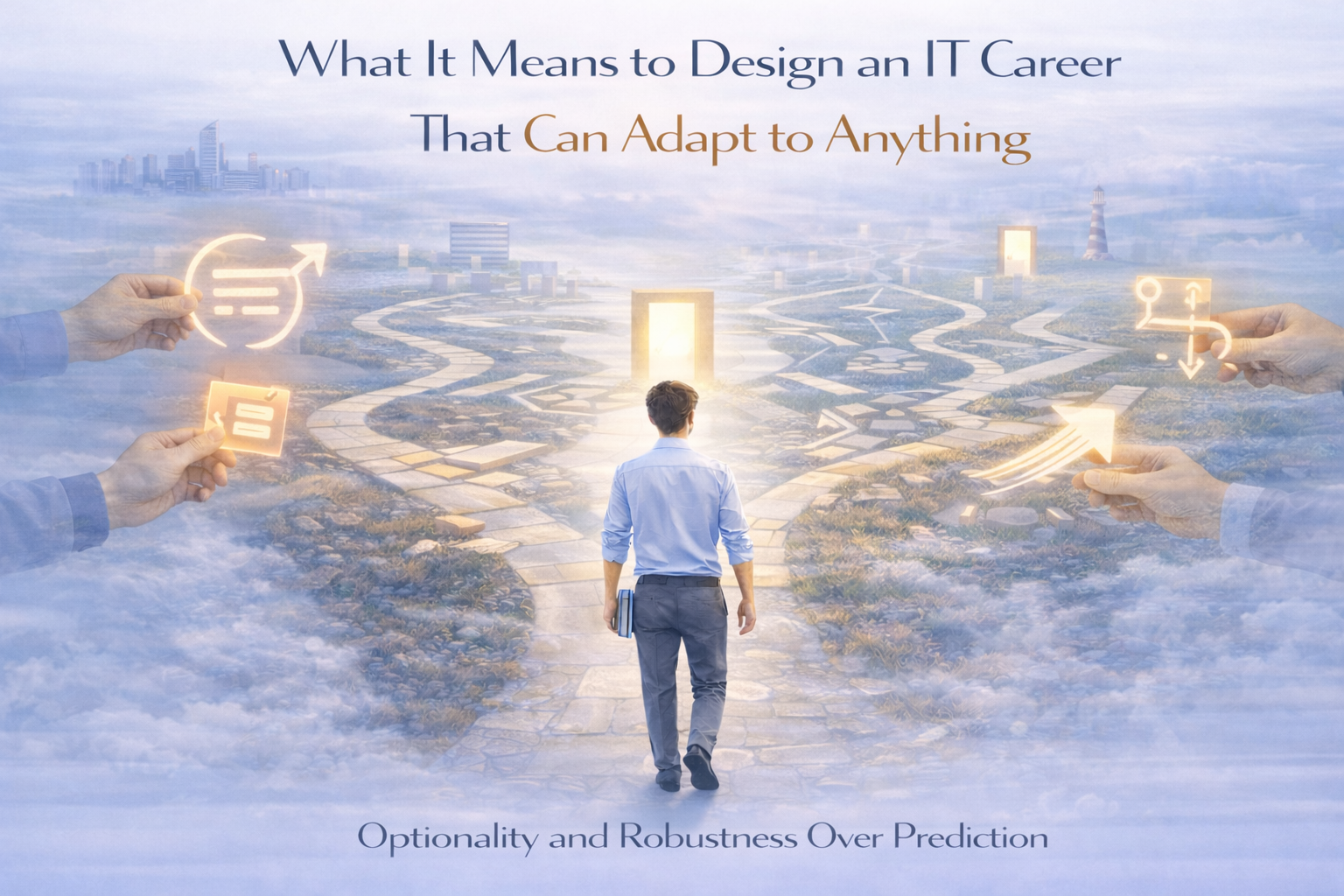
Most IT professionals try to predict the future.
Which technology will win.
Which role will grow.
Which domain will stay relevant.
Career planning often becomes an exercise in prediction.
But long-lasting IT careers are not built on prediction.
They are built on adaptability.
Why Prediction Fails in IT Careers
The IT landscape changes faster than plans can keep up:
- Technologies rise and fall
- Roles merge, split, or disappear
- Business priorities shift unexpectedly
Even well-informed predictions expire.
Careers designed around a single future scenario become fragile when reality diverges.
Robustness vs Prediction
Adaptive careers focus on robustness, not accuracy.
Robust careers:
- Survive multiple futures
- Absorb shocks without collapse
- Adjust direction without restarting
Prediction-based careers work only if the forecast is right.
Robust careers work even when it’s wrong.
Flexible Identity Is the Core Asset
The most adaptable professionals are not defined by tools.
They are defined by:
- The kinds of problems they solve
- The decisions they influence
- The outcomes they improve
Flexible identity allows movement across roles, technologies, and domains.
Rigid identity limits adaptation.
Designing for Change, Not Stability
Stability feels desirable.
But stability without options is vulnerability.
Designing for adaptability means:
- Choosing roles that expand exposure
- Building skills that transfer
- Maintaining optional paths
- Avoiding irreversible commitments too early
Change becomes navigable instead of threatening.
Future-Proof Thinking Is About Optionality
Future-proof careers are not immune to disruption.
They are prepared for it.
Optionality provides:
- Faster recovery from setbacks
- Better negotiation power
- Freedom to choose when change is needed
The future rewards those who can move, not those who guessed correctly.
Signals That a Career Is Adaptable
Adaptive careers show patterns:
- Multiple credible next steps
- Skills used in more than one context
- Influence that survives role changes
- Learning that continues even during success
These signals matter more than titles or plans.
Designing an Adaptive Career Intentionally
Adaptability doesn’t happen by accident.
Practical design principles:
- Protect optionality even during good times
- Revisit identity regularly
- Rotate problem spaces over time
- Ask: “If this stops working, what’s my next move?”
Designing for change reduces fear of change.
Final Thought
The strongest IT careers are not the most optimized.
They are the most adaptable.
In a field defined by uncertainty, long-term success belongs to professionals who don’t try to predict what comes next —
But design careers that can handle anything that does.