Most IT professionals judge career decisions by how they feel right now.
Does the role pay more?
Does the work feel manageable?
Does the decision reduce stress?
If the answer is yes, the decision feels correct.
The problem is that many career decisions in IT don’t reveal their true impact immediately. The cost shows up years later — when changing direction is harder.
The Time-Lag Effect in IT Careers
In engineering, cause and effect are often close together.
In careers, they are not.
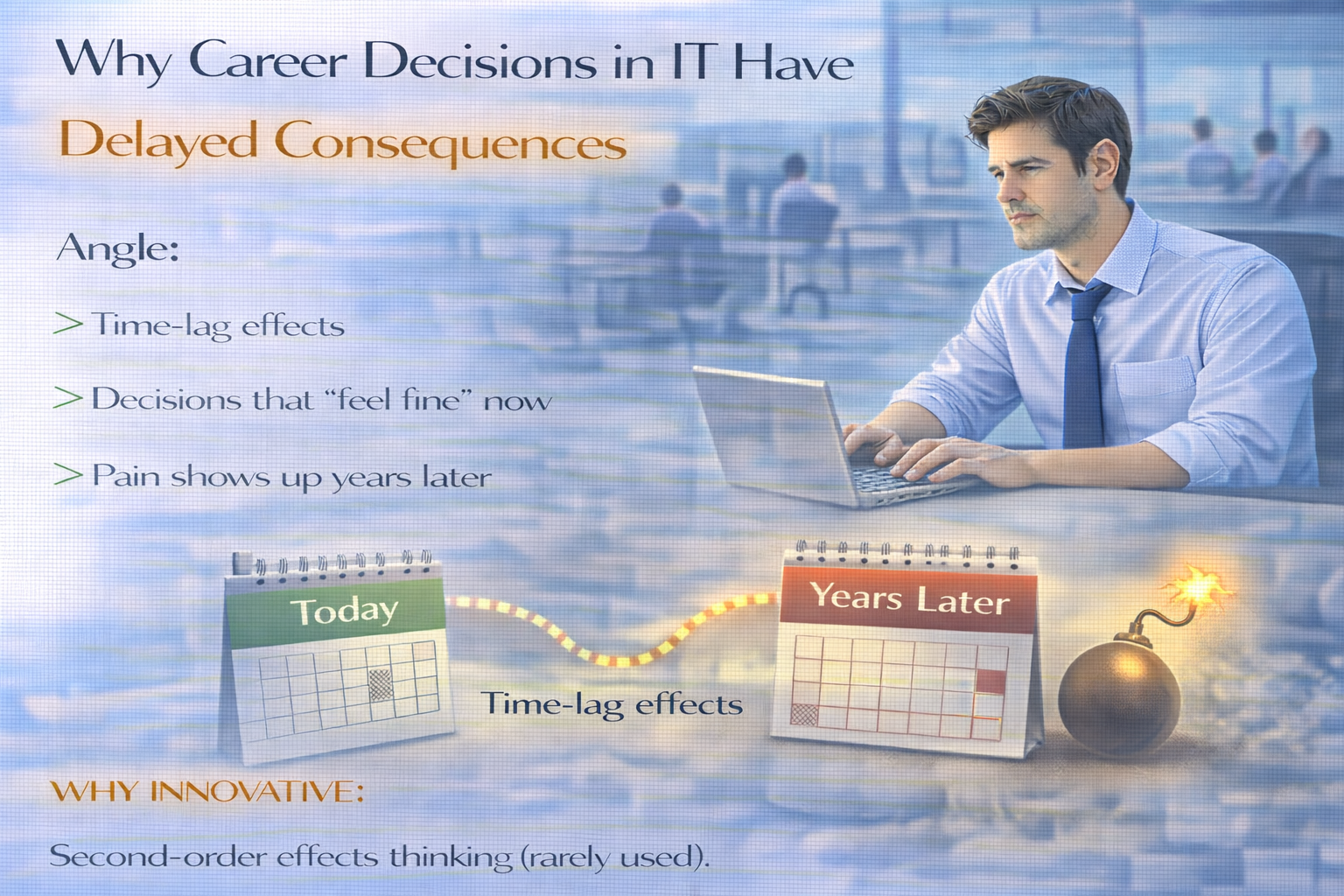
Many IT career decisions have a time lag between action and outcome:
- A comfortable role delays skill growth — pain appears years later
- A narrow specialization feels rewarding — limitation appears later
- Avoiding risk feels safe — stagnation appears gradually
By the time the effect is visible, the original decision feels distant and harmless.
Decisions That “Feel Fine” Today
The most dangerous career decisions are not risky ones.
They are decisions that feel reasonable:
- Staying one more year because things are stable
- Accepting work that doesn’t stretch you
- Postponing learning because deadlines exist
- Choosing familiarity over exploration
Nothing breaks.
Nothing fails.
But something stops growing.
Why Pain Appears Years Later
Delayed consequences accumulate quietly.
Each year of limited exposure:
- Reduces adaptability
- Narrows professional identity
- Increases switching costs
- Weakens external market relevance
When the market shifts or disruption occurs, the damage surfaces suddenly — even though it was years in the making.
Second-Order Effects in IT Careers
Second-order effects are indirect consequences.
In IT careers, they include:
- What you stop learning because of a choice
- Opportunities you no longer qualify for
- Networks you fail to build
- Confidence you lose in unfamiliar domains
These effects compound invisibly.
The original decision may still look “correct” on paper — even as its consequences grow.
Why Professionals Misread Cause and Effect
Humans are wired to connect recent actions with recent outcomes.
When years separate cause and consequence:
- We blame the market
- We blame age or timing
- We blame bad luck
Rarely do we trace the outcome back to earlier, comfortable decisions.
How to Think Beyond Immediate Outcomes
Smarter career decisions require asking different questions:
- What skills will this role prevent me from developing?
- How does this choice affect my options three years from now?
- What future paths does this decision quietly close?
Decisions should be evaluated not only by immediate relief — but by future flexibility.
Final Thought
IT careers rarely break suddenly.
They weaken silently through delayed consequences.
The most important career skill is not prediction —
It is the ability to think beyond what feels fine today.