Many IT professionals avoid role changes for one simple reason.
They fear starting over.
New credibility.
New identity.
New learning curve.
This fear keeps people stuck longer than necessary.
But most IT role changes do not require a reset.
They require carryover leverage.
Why Role Changes Feel Like Resets
Role changes feel like resets when:
- Past experience isn’t translated
- Identity is erased instead of evolved
- Early value isn’t made visible
The problem is not the role change.
It’s the way the transition is framed and executed.
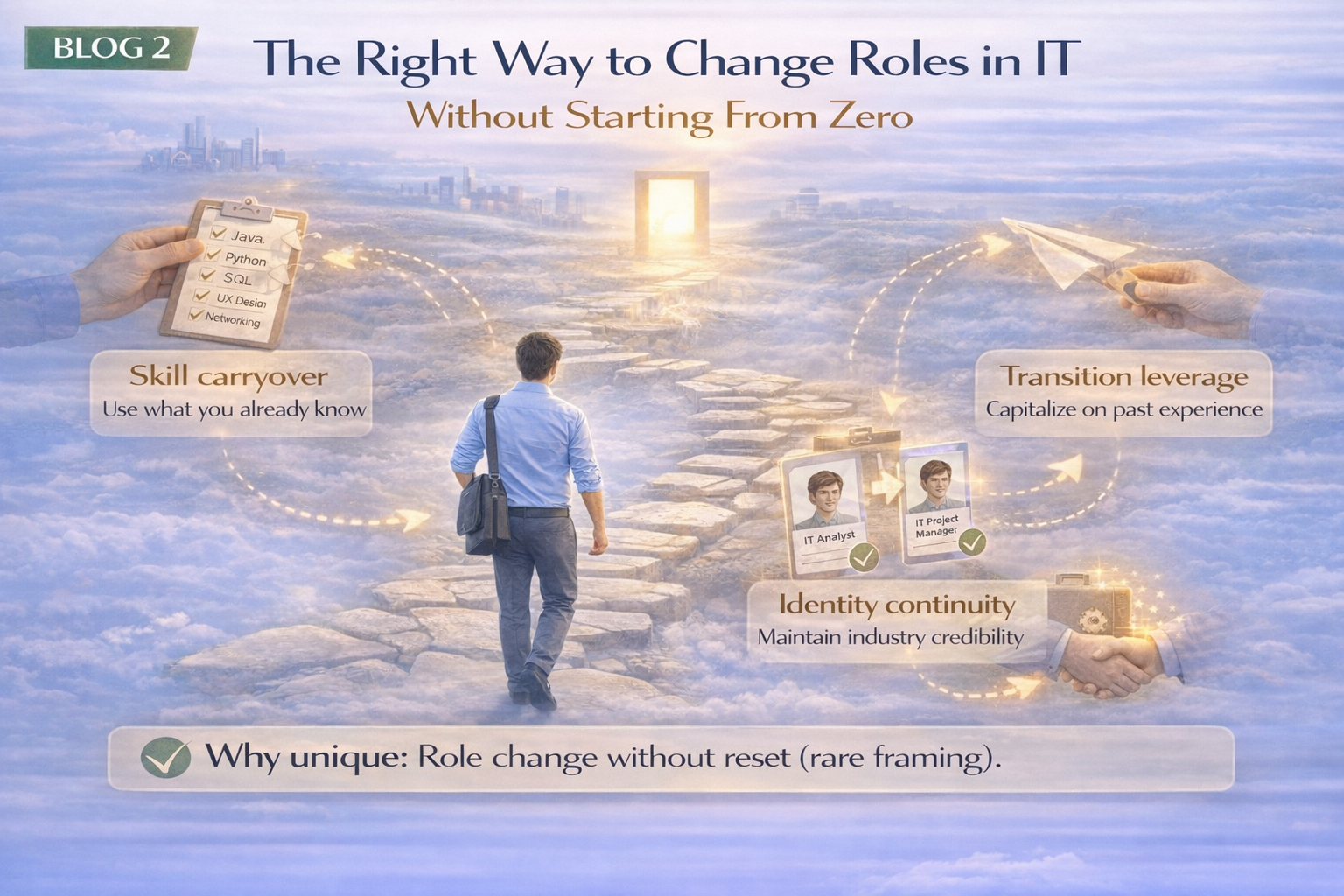
Skill Carryover Is the Core Advantage
Skills rarely disappear.
They transfer.
Common carryovers include:
- Problem-solving patterns
- System understanding
- Debugging instincts
- Communication with stakeholders
Professionals who identify and articulate these carryovers avoid starting from zero.
Identity Continuity Matters More Than Titles
Successful role changers don’t abandon identity.
They reshape it.
Instead of:
“I used to be X, now I’m Y”
They signal:
“I solve this category of problems — now in a different context”
Continuity builds trust faster than reinvention.
Transition Leverage Comes from Early Impact
Early wins are not accidental.
They are engineered.
Strong transitions focus on:
- High-visibility problems
- Clear pain points
- Areas where past experience applies immediately
Early impact compresses credibility timelines.
Why Many Role Changes Fail Quietly
Failures often look like this:
- Long ramp-up
- Low confidence
- Being treated as junior
Not because ability is missing —
But because leverage wasn’t applied.
Designing a Non-Zero Reset Transition
Changing roles without resetting requires intention.
Practical principles:
- Map old skills to new outcomes
- Signal strengths before learning gaps
- Anchor credibility early
- Avoid roles that erase your past entirely
Transitions should compound, not restart.
Final Thought
The best IT role changes don’t erase history.
They reuse it.
Professionals who carry value forward change roles without losing momentum —
And often grow faster than those who stay put.