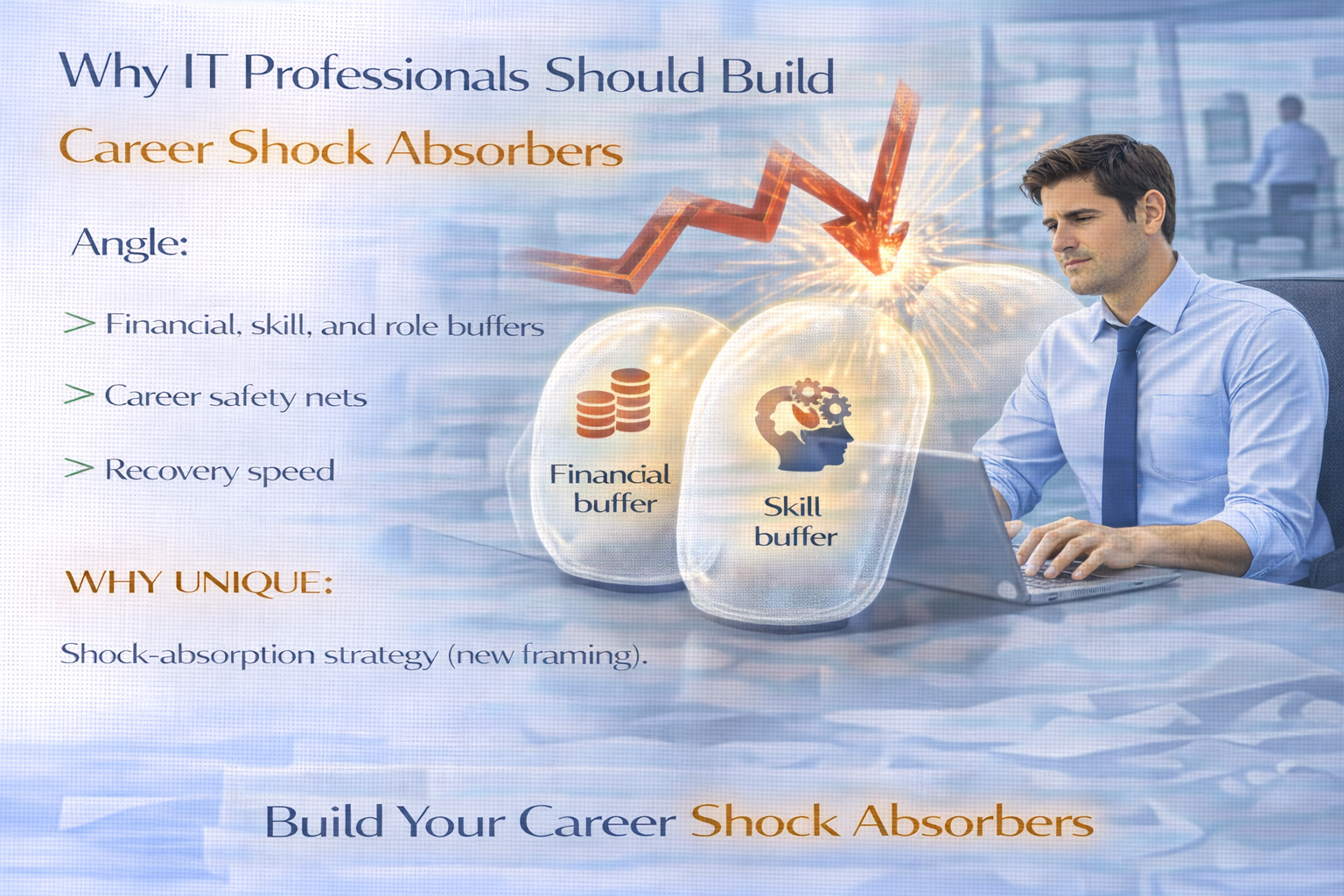
Most IT professionals plan their careers for growth.
Very few plan for impact.
Market crashes, technology shifts, layoffs, failed projects, health issues, or personal constraints can hit even the most talented professionals. Careers don’t usually fail because of lack of ambition — they fail because they lack shock absorption.
A strong IT career is not one that avoids shocks, but one that absorbs them and recovers fast.
What Is a Career Shock Absorber?
A career shock absorber is any buffer that reduces damage when disruption occurs.
In mechanical systems, shock absorbers don’t prevent bumps — they prevent breakdown.
In careers, shock absorbers:
- Reduce sudden income loss
- Prevent skill obsolescence
- Speed up recovery after setbacks
- Preserve confidence and decision-making ability
They don’t make you invincible — they make you resilient.
The Three Critical Career Shock Absorbers in IT
1. Financial Shock Absorbers
Money doesn’t create career stability, but lack of it destroys options.
Financial buffers give you:
- Time to think instead of panic
- Ability to reject bad roles
- Freedom to reskill strategically
Even a few months of runway dramatically improves career outcomes after disruption.
2. Skill Shock Absorbers
Skills decay faster than most professionals realize.
Skill shock absorbers are liquid skills — skills that:
- Transfer across domains
- Apply to multiple tech stacks
- Solve business problems, not just technical tasks
Examples include system thinking, debugging complex flows, architecture understanding, communication, and adaptability.
The more liquid your skills, the less damage any single market shift can cause.
3. Role Shock Absorbers
Careers break when professionals lock themselves into a single role identity.
Role shock absorbers come from:
- Exposure to adjacent roles
- Cross-functional understanding
- Ability to reposition yourself (developer → lead → consultant → architect)
This flexibility allows you to stay relevant even when specific roles lose demand.
Why Most IT Careers Break Without Warning
Career shocks rarely announce themselves.
The danger zone is when:
- Income depends on one employer
- Skills depend on one stack
- Identity depends on one title
When all three align, even a small disruption can cause disproportionate damage.
Recovery Speed Matters More Than Stability
Two professionals can face the same setback.
One recovers in three months.
Another struggles for three years.
The difference is not talent — it is shock absorption capacity.
Careers today are less about avoiding risk and more about recovering fast.
How to Start Building Career Shock Absorbers
You don’t need radical changes.
Start with:
- Building a modest financial buffer
- Strengthening transferable skills
- Expanding role awareness beyond your job title
- Maintaining external professional visibility
- Periodically stress-testing your career assumptions
Small buffers compound into long-term resilience.
Final Thought
IT careers are no longer linear.
The professionals who last are not the most aggressive — they are the most prepared.
Build shock absorbers before you need them.
Because recovery speed decides careers, not just growth.