Freshers and experienced professionals often believe they are evaluated using the same standards. From the company’s side, this is not true.
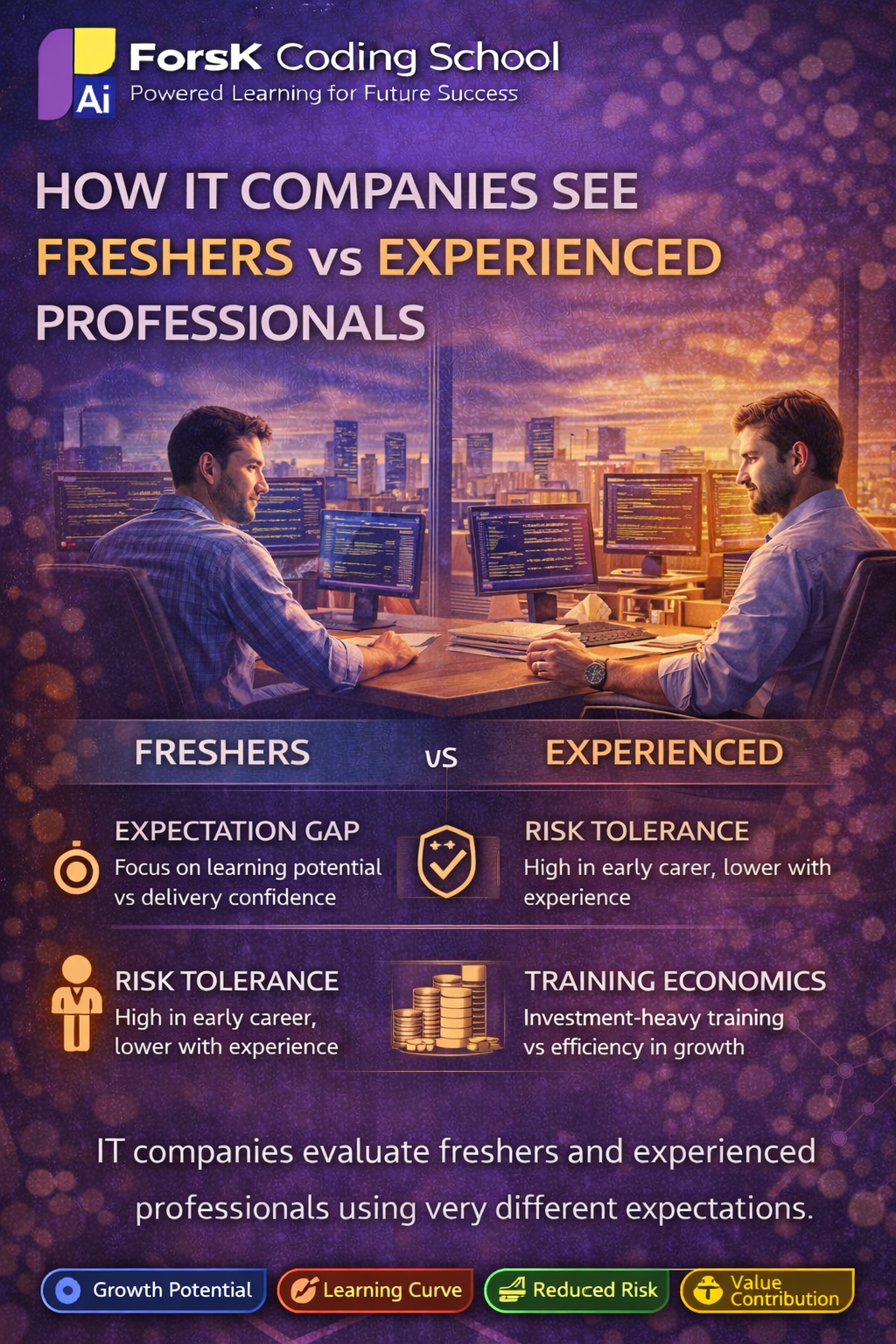
IT companies look at freshers and experienced professionals through very different lenses, shaped by expectations, risk tolerance, and training economics.
Understanding this difference helps professionals align their behavior with what companies actually value.
The Expectation Gap
For freshers, companies expect:
- Limited real-world exposure
- Higher learning needs
- More supervision
For experienced professionals, companies expect:
- Independent execution
- Sound judgment
- Problem anticipation
A fresher making mistakes is normal.
An experienced professional making the same mistakes is a red flag.
Risk Tolerance Is Not Equal
Companies accept higher risk with freshers.
Why?
- Lower responsibility scope
- Limited client exposure
- Training mindset
With experienced professionals, risk tolerance drops sharply.
Mistakes at higher levels:
- Impact clients
- Damage trust
- Increase costs
This is why expectations rise steeply with experience.
Training Economics Explained
Training a fresher is an investment project.
Companies expect:
- Slow initial output
- Gradual productivity
- Long-term retention
Training experienced professionals is different.
Companies expect:
- Faster impact
- Immediate contribution
- Lower learning curve
When experienced hires need excessive training, ROI drops.
How Companies Measure Value at Each Stage
Freshers are evaluated on:
- Learning attitude
- Consistency
- Coachability
- Effort to improve
Experienced professionals are evaluated on:
- Decision quality
- Reliability
- Business understanding
- Impact on others
Same company. Different scorecards.
Why Experience Alone Is Not Enough
Years of experience do not automatically increase value.
Companies ask:
- Has complexity handled increased?
- Has responsibility grown?
- Has judgment improved?
Stagnant experience is treated closer to fresher-level risk.
Career Growth Depends on Alignment
Professionals who understand these expectations:
- Transition roles more smoothly
- Avoid career stagnation
- Gain trust faster
Those who don’t often feel unfairly treated.
Final Thoughts
IT companies do not see careers as linear timelines.
They see them as risk and value curves.
Freshers are growth bets.
Experienced professionals are reliability bets.
Understanding which bet you represent—and behaving accordingly—determines how far and how fast your career grows.