From the outside, it often feels unfair. Two employees join at similar times, work similar hours, and yet one receives better projects, more training, higher raises, and stronger long-term support from the company.
This is rarely personal.
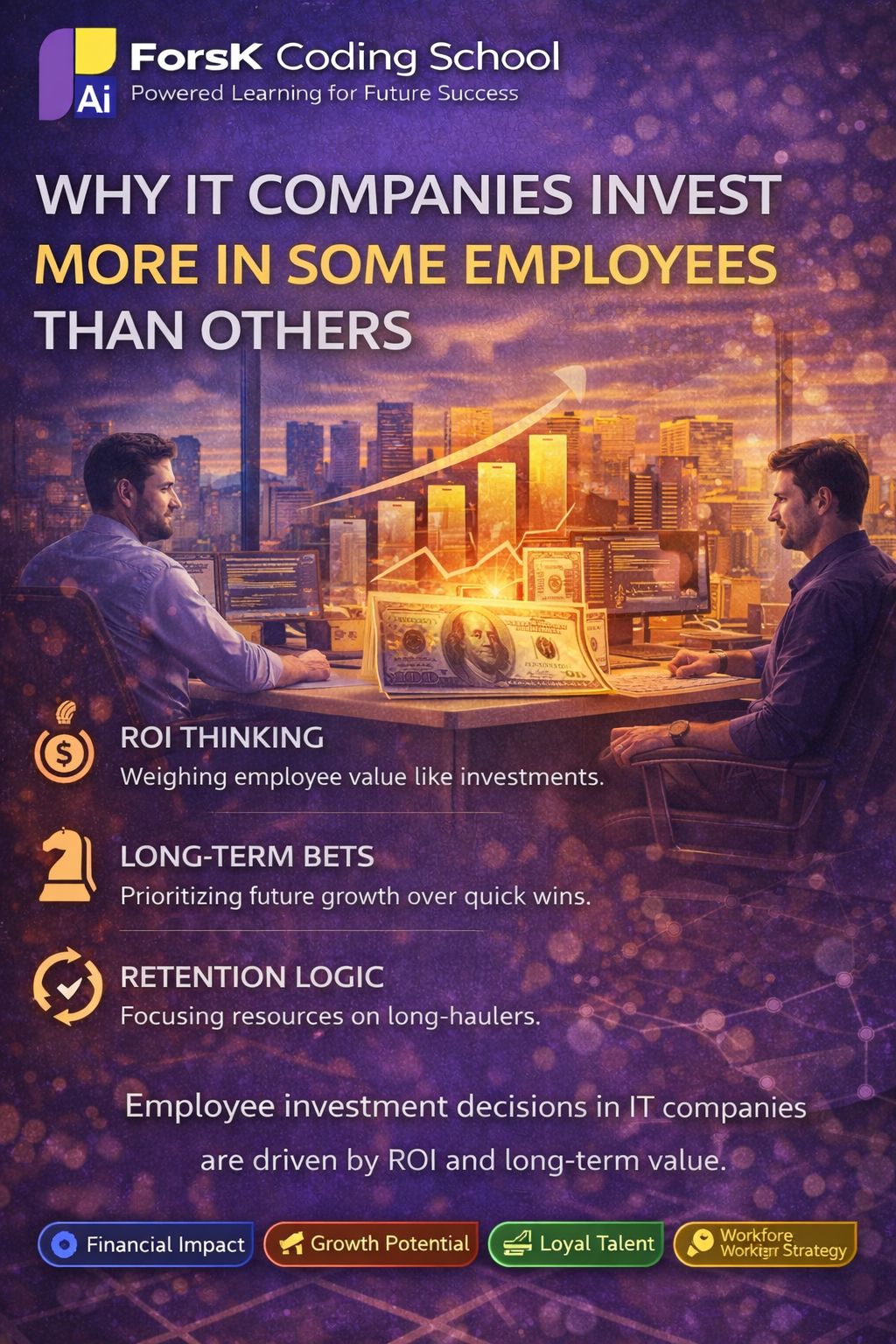
IT companies invest in employees the same way they invest in products, systems, or clients—through ROI thinking and long-term risk assessment.
This blog explains the logic from the employer’s perspective, not from employee expectations.
Employees Are Business Investments
Every company has limited resources:
- Time
- Money
- Leadership attention
- Training budgets
When a company invests more in an employee, it is making a calculated bet.
The key question is:
Where will this investment produce the highest long-term return?
ROI Thinking: What Companies Actually Measure
Return on investment for employees is not about effort alone.
Companies look for:
- Ability to handle increasing responsibility
- Reduction of managerial overhead
- Reliability under pressure
- Long-term usefulness across roles or projects
An employee who lowers operational risk generates higher ROI.
Long-Term Bets vs Short-Term Performers
Some employees deliver well in the short term but create long-term instability.
Others may grow slower initially but become highly valuable over time.
Companies prefer long-term bets—people who:
- Learn steadily
- Adapt without resistance
- Stay relevant as systems evolve
- Can be trusted beyond narrow tasks
Investment follows longevity potential.
Retention Logic: Why Some People Are Protected
Retention is expensive.
Replacing experienced employees costs:
- Hiring time
- Training effort
- Knowledge loss
- Client confidence
Companies invest more in employees who are:
- Hard to replace
- Deeply familiar with systems
- Trusted by clients or internal teams
These employees become continuity anchors.
Why Hard Work Alone Doesn’t Trigger Investment
Hard work is expected.
Investment is selective.
Companies invest when employees:
- Think beyond assigned tasks
- Understand business impact
- Reduce dependency on supervision
- Grow in judgment, not just output
Investment follows value multiplication.
The Hidden Signal: Scalability
One powerful question companies ask:
“Can this person scale?”
Scaling means:
- Handling bigger scope
- Managing ambiguity
- Supporting others
Employees who scale receive disproportionate investment.
Final Thoughts
IT companies do not invest emotionally.
They invest strategically.
If you want more investment, think less about visibility and more about becoming a low-risk, high-return professional.
From a company’s point of view, investment is not about who tries hardest.
It is about who strengthens the business over time.