From the outside, it often looks mysterious. Two employees with similar experience, similar skills, even similar performance reviews—yet one starts getting more responsibility, bigger projects, and closer access to decision-makers.
This is usually misunderstood as favoritism or luck.
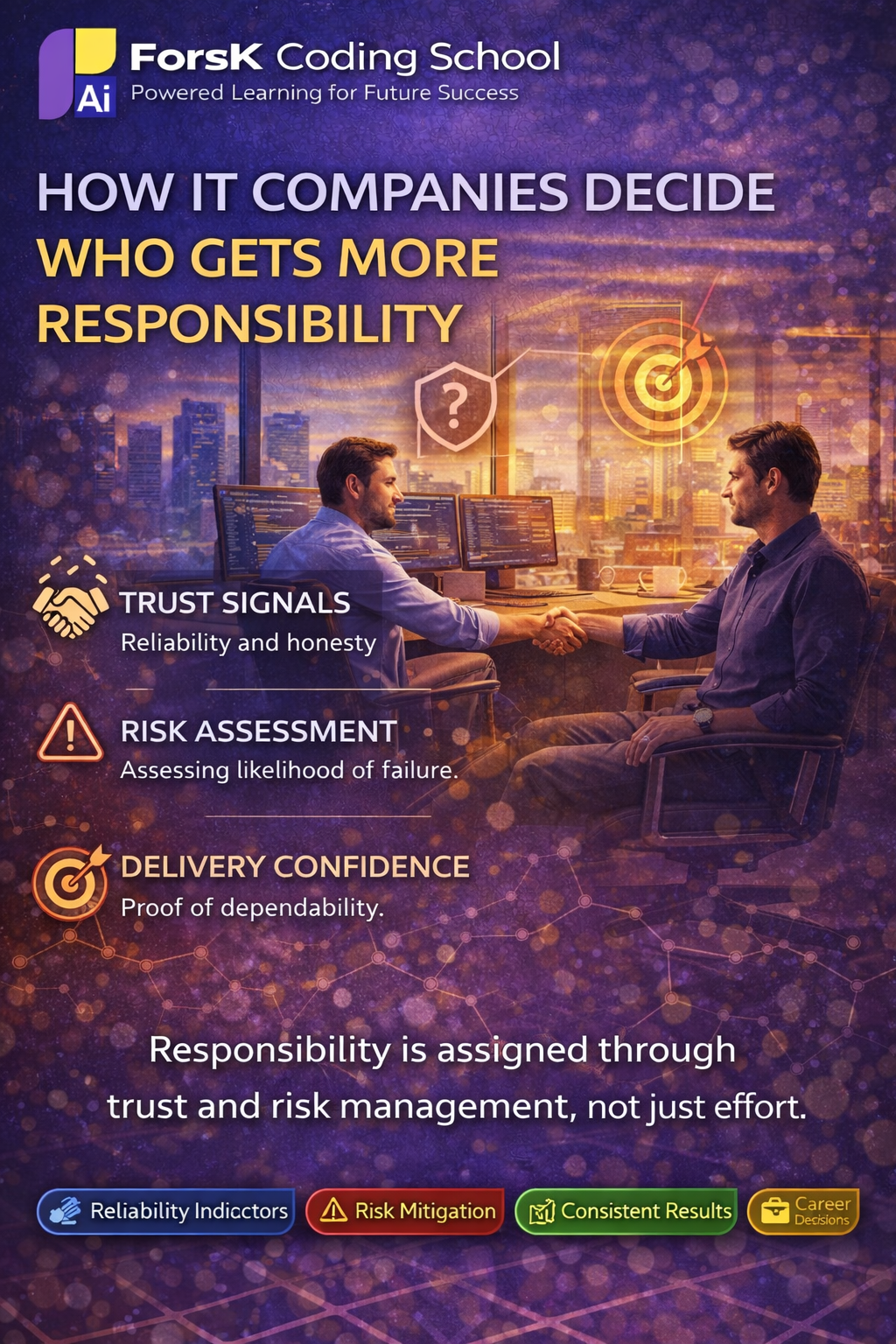
In reality, IT companies follow a decision-making logic that is very different from what most employees imagine. Responsibility is not assigned based on effort alone. It is assigned based on risk management and trust.
This blog looks at the decision from the company’s perspective, not the employee’s expectations.
Responsibility Is a Risk Decision
Every additional responsibility carries risk for a company.
When a manager assigns ownership of a system, client, or delivery milestone, they are asking:
- What can go wrong?
- How costly would failure be?
- How predictable is this person under pressure?
Responsibility is not a reward. It is a risk transfer.
Companies give responsibility to people who reduce uncertainty.
Trust Signals Companies Look For
Trust is not built through words. It is built through repeated signals.
Key trust signals include:
- Consistent delivery, not heroic last-minute saves
- Clear communication when things are unclear
- Early escalation of risks
- Ownership mindset instead of task completion mindset
Employees who quietly manage risk earn trust faster than those who only work hard.
Delivery Confidence Matters More Than Speed
Fast work is impressive.
Reliable work is valuable.
From a company’s point of view, delivery confidence means:
- Timelines are realistic
- Commitments are honored
- Surprises are minimized
Someone who delivers slightly slower but predictably is often trusted more than someone who delivers fast but inconsistently.
How Managers Think During Risk Assessment
When deciding whom to trust with more responsibility, managers subconsciously ask:
- Will this person inform me early if something goes wrong?
- Can I leave this project unattended for some time?
- Do they understand downstream impact?
If the answer feels safe, responsibility increases.
Why Effort Alone Is Not Enough
Many professionals assume working harder automatically leads to more responsibility.
Effort without judgment increases risk.
Companies value:
- Decision quality
- Situational awareness
- Calm handling of ambiguity
Responsibility follows reliability, not exhaustion.
The Hidden Cost of Wrong Responsibility Assignment
Assigning responsibility to the wrong person can result in:
- Client dissatisfaction
- Missed deadlines
- Team stress
- Reputation damage
Because the cost is high, companies are conservative.
How Responsibility Grows Over Time
Responsibility usually grows in layers:
- Task ownership
- Module ownership
- System ownership
- Client or business ownership
Each layer requires higher trust and lower perceived risk.
Final Thoughts
IT companies do not decide responsibility emotionally.
They decide it strategically.
If you want more responsibility, focus less on appearing busy and more on becoming predictable, trustworthy, and risk-aware.
From a company’s view, responsibility is not about who works the hardest.
It is about who makes the business feel safe.