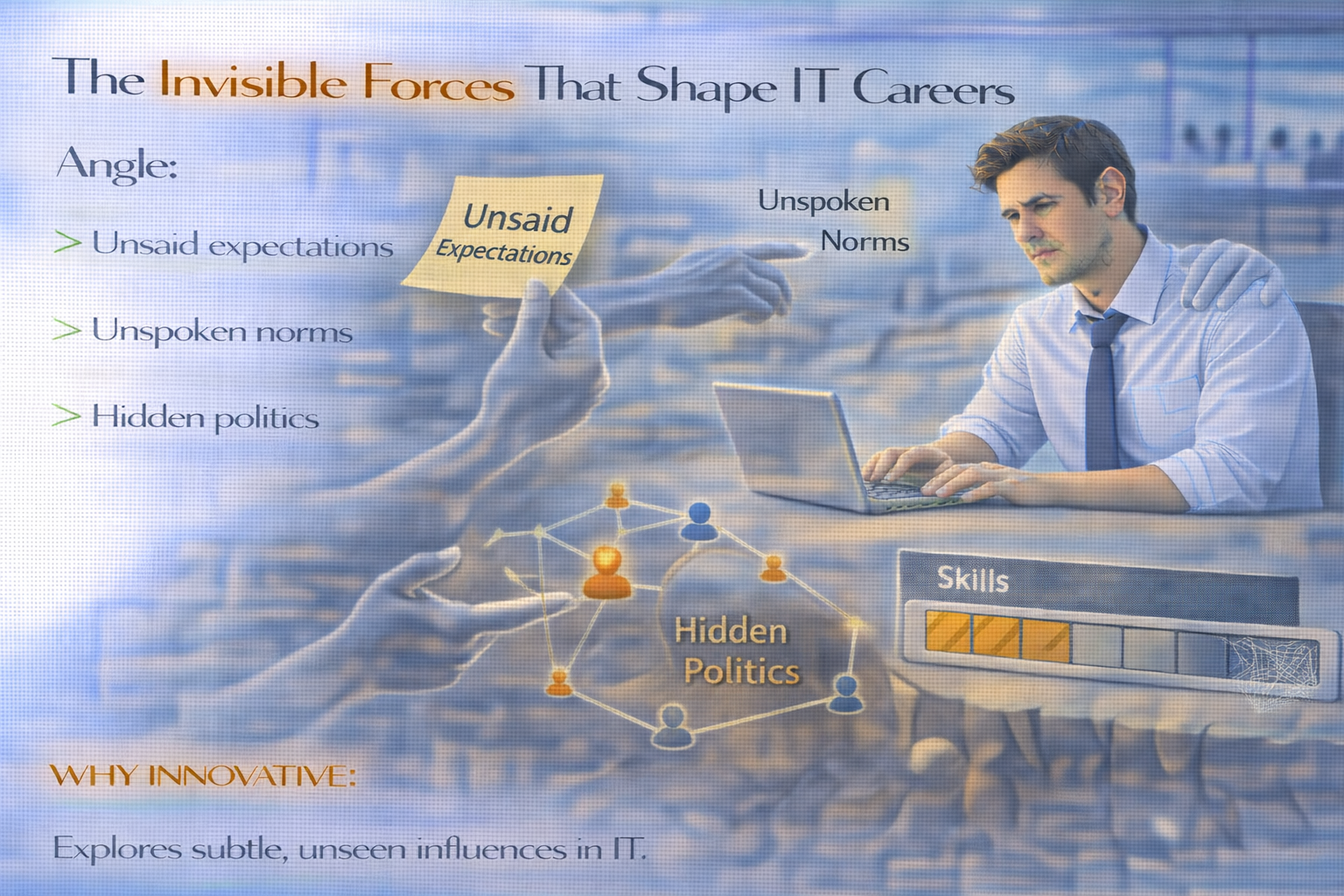
Most IT professionals believe careers are shaped by visible decisions.
The role you accept.
The technology you choose.
The company you join.
But some of the strongest forces shaping IT careers operate below awareness.
They don’t announce themselves.
They don’t feel like choices.
They quietly condition behavior — and over time, determine outcomes.
The Problem of Attention Blindness in Careers
Humans notice what changes.
We rarely notice what stays constant.
In IT careers, this creates attention blindness:
- You notice salary hikes, not skill stagnation
- You notice deadlines, not narrowing exposure
- You notice promotions, not shrinking option space
What you don’t notice keeps accumulating influence.
Invisible Constraints That Shape Decisions
Every work environment creates constraints you slowly adapt to:
- Internal tools that limit how you think about systems
- Company-specific processes mistaken for industry norms
- Team expectations that define what “good work” looks like
Because these constraints are invisible, they feel natural.
You don’t feel restricted — you feel normal.
Unquestioned Assumptions That Lock Careers
Careers often drift because assumptions go unexamined:
- “This experience will always be valuable”
- “I can switch later”
- “This is how things are done in IT”
Assumptions shape behavior long before they are tested.
When reality finally challenges them, adaptation becomes expensive.
Environmental Conditioning in IT Roles
People adapt to their environment faster than they realize.
Over time:
- Problem-solving style narrows
- Curiosity declines outside assigned scope
- Comfort replaces exploration
The environment doesn’t force this.
It rewards it.
Why These Forces Are Hard to Detect
Invisible forces don’t trigger alarms.
Performance reviews remain positive.
Work feels productive.
Life feels stable.
Only later do professionals realize:
- Their experience is less transferable than expected
- Their thinking is context-bound
- Their confidence drops outside familiar environments
The shaping happened silently.
How to Make the Invisible Visible
You can’t change what you don’t see.
Practical ways to regain awareness:
- Regularly compare your skills with market expectations
- Expose yourself to different teams, systems, or domains
- Question processes you treat as “normal”
- Ask what your role discourages you from learning
Attention restores agency.
Final Thought
IT careers are shaped as much by inaction as action.
By what you don’t question.
By what you stop noticing.
The most dangerous career forces are not visible threats —
They are invisible habits that slowly define who you become.