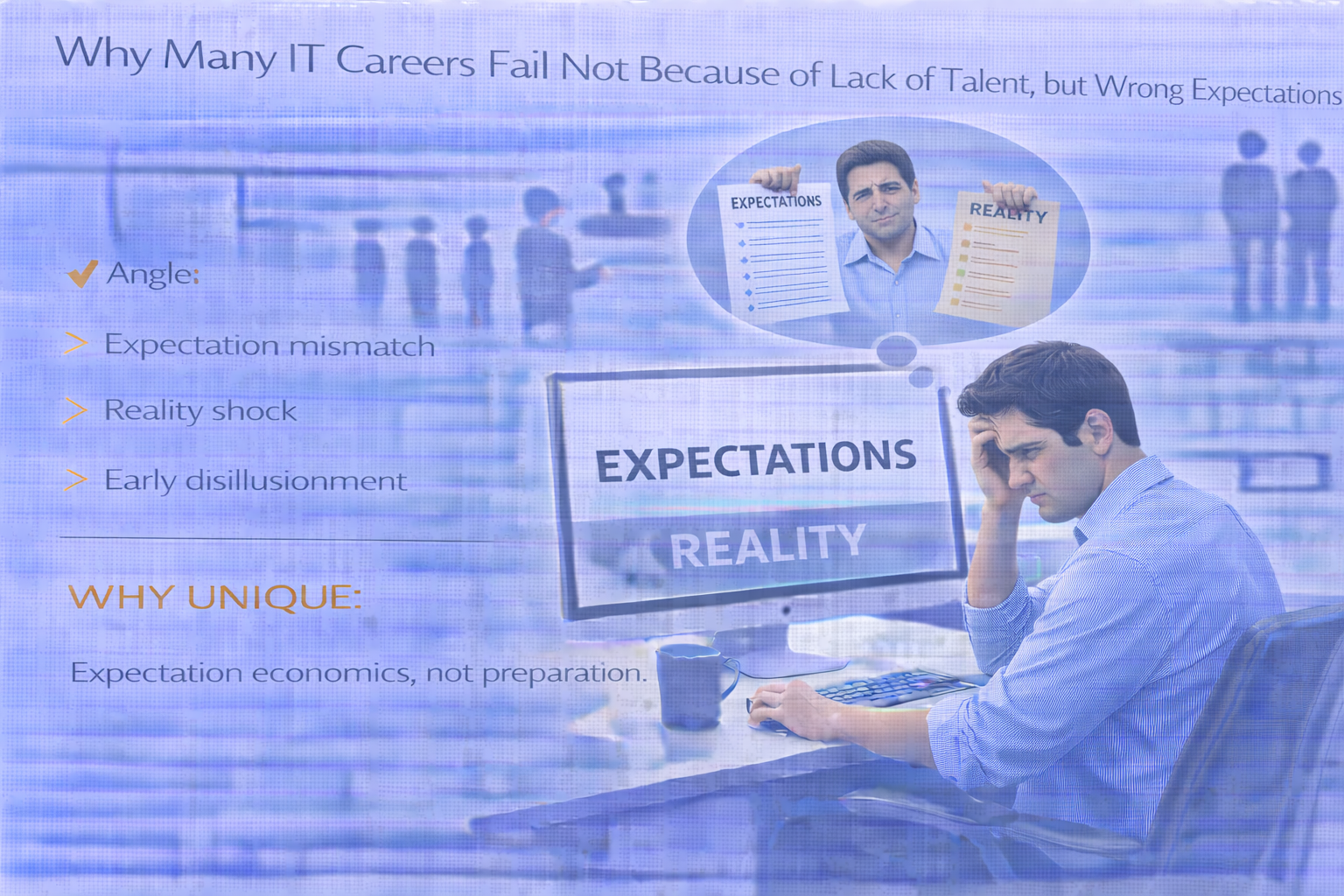
Why Many IT Careers Fail Not Because of Lack of Talent, but Wrong Expectations
In the IT industry, career failure is often blamed on lack of talent, poor skills, or insufficient preparation. But many IT careers derail for a different reason altogether — wrong expectations.
This blog explores how expectation mismatch, reality shock, and early disillusionment quietly damage IT careers, and why expectation economics matters more than preparation alone.
Expectation Mismatch: When Reality Doesn’t Match the Mental Model
Many professionals enter IT with expectations shaped by:
- Social media success stories
- Fast salary growth narratives
- Startup glamour
- “Six-figure in two years” promises
The reality is different:
- Slow, uneven growth
- Repetitive and unglamorous work
- Long learning curves
- Delayed rewards
When expectations are inflated, even normal career challenges feel like failure. The problem is not performance — it is mismatch.
Reality Shock: The First Career Collision
Reality shock hits when professionals realize:
- Learning never truly ends
- Work is constrained by business needs
- Recognition is inconsistent
- Progress is not linear
This shock creates confusion and self-doubt. Instead of adjusting expectations, many interpret discomfort as a sign they don’t belong in IT.
Early Disillusionment: Losing Belief Too Soon
Disillusionment often appears early — within the first few years.
Signs include:
- Feeling misled about the profession
- Comparing growth with unrealistic benchmarks
- Losing motivation despite capability
- Questioning career choice prematurely
Talented professionals exit or disengage not because they can’t succeed, but because the emotional cost of unmet expectations feels too high.
Why This Is Expectation Economics, Not Preparation
Preparation focuses on skills and knowledge. Expectation economics focuses on perceived return versus effort.
When effort feels higher than expected reward:
- Motivation drops
- Persistence weakens
- Career commitment erodes
Careers don’t fail when skills are missing — they fail when the expected payoff feels unfair.
Resetting Expectations for Sustainable IT Careers
Healthy expectation resets include:
- Viewing IT careers as long-term compounding systems
- Normalizing slow and uneven growth
- Separating online narratives from personal timelines
- Measuring progress in years, not months
Correct expectations turn friction into patience instead of frustration.
Final Thoughts
Many IT careers fail not because of lack of talent, but because expectations were built on myths instead of reality.
When professionals align expectations with how IT careers actually work, persistence increases — and talent finally gets time to compound.
In IT, right expectations outperform raw talent.