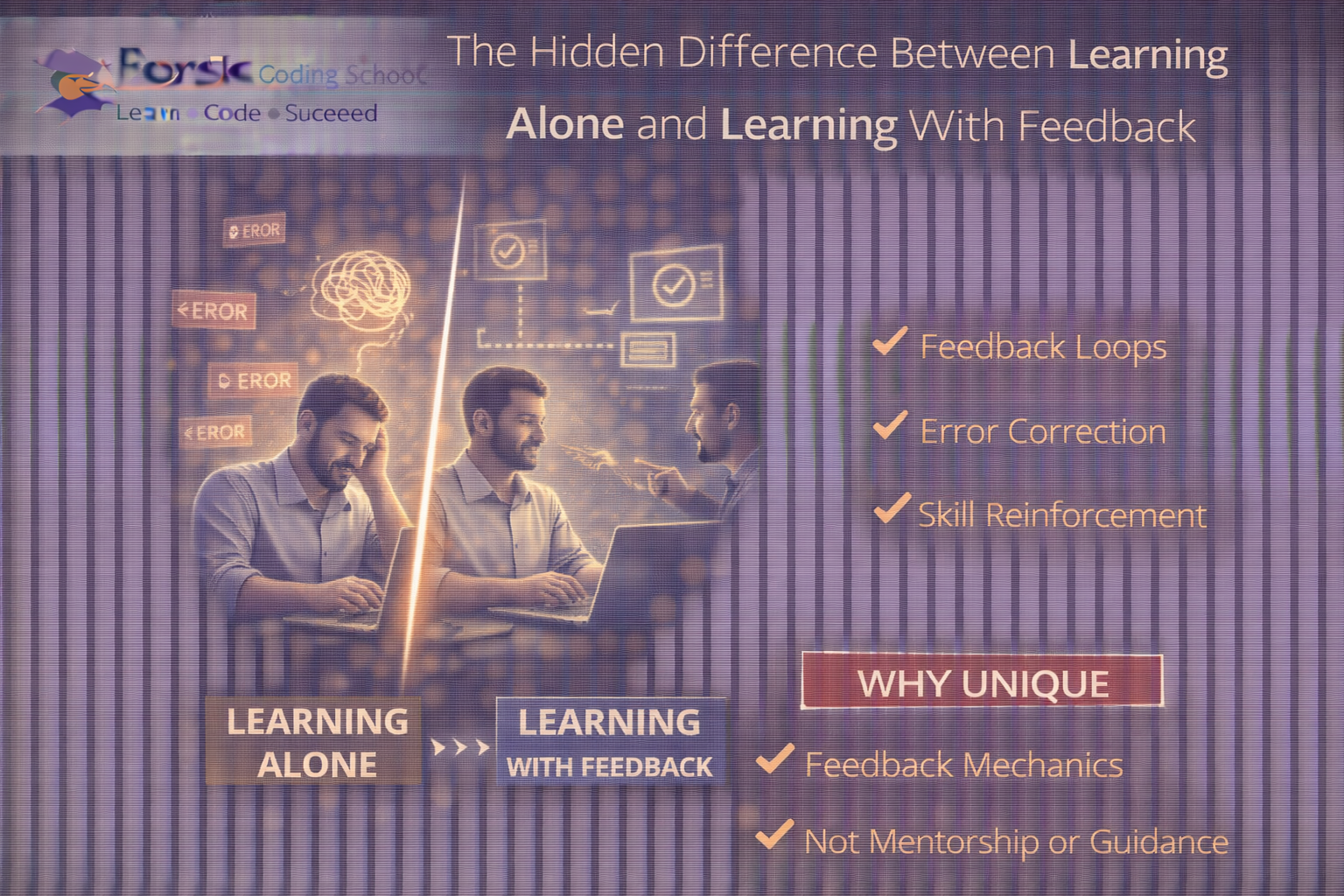
The Hidden Difference Between Learning Alone and Learning With Feedback
Many IT professionals believe that consistent self-study is enough to grow. They read documentation, watch tutorials, build side projects, and practice regularly. Yet, despite serious effort, progress often feels slower than expected.
The missing factor is rarely motivation or discipline. It is feedback.
This blog explains the hidden difference between learning alone and learning with feedback—focusing on feedback loops, error correction, and skill reinforcement. This is not about mentorship or guidance. It is about learning mechanics.
Learning Alone: Progress Without Calibration
Learning alone is efficient for exposure but weak for correction.
When professionals learn in isolation:
- Mistakes go unnoticed
- Partial understanding feels complete
- Inefficient habits become permanent
Without external signals, the brain assumes correctness. This creates confidence without calibration.
Feedback Loops: The Engine of Real Learning
A feedback loop is a cycle where actions produce signals that adjust future behavior.
In effective IT learning, feedback:
- Confirms what is correct
- Exposes what is wrong
- Narrows the gap between intent and outcome
Fast learners shorten feedback loops. Slow learners operate without them.
Error Correction Happens Only With Feedback
Errors are not harmful—uncorrected errors are.
Learning alone often delays error detection:
- Code works but is inefficient
- Designs function but do not scale
- Logic passes tests but fails edge cases
Feedback surfaces errors early, when they are cheap to fix and easy to understand.
Skill Reinforcement vs Skill Illusion
Repetition without feedback reinforces behavior, not skill.
This creates skill illusion:
- Doing the same thing repeatedly
- Feeling smoother without becoming better
- Confusing familiarity with mastery
With feedback, repetition strengthens correct patterns and weakens incorrect ones—creating real skill reinforcement.
Why Feedback Accelerates Learning Curves
Feedback compresses learning time by:
- Eliminating guesswork
- Preventing habit drift
- Improving decision quality
Professionals receiving timely feedback adapt faster—even with fewer study hours.
Why This Is Not About Mentorship
Feedback does not require a mentor.
It can come from:
- Code reviews
- System behavior under load
- Failed deployments
- Precise test results
The source matters less than the signal quality.
How to Build Feedback Into Solo Learning
Practical ways to add feedback loops:
- Compare multiple solutions to the same problem
- Test edge cases aggressively
- Explain decisions and validate them
- Review failures systematically
Learning improves when feedback becomes unavoidable.
Final Thoughts
The hidden difference between learning alone and learning with feedback is not effort—it is correction.
Feedback turns activity into improvement.
In IT, progress accelerates not by learning harder, but by learning with feedback.