In the IT industry, information is everywhere.
Salary reports, roadmap videos, LinkedIn threads, mentorship advice, tech comparisons, bootcamps, podcasts.
Yet despite having access to more data than ever before, many IT professionals still make poor career decisions.
The problem is rarely lack of knowledge.
It is poor decision hygiene.
This blog explores why good information does not automatically produce good decisions—and how judgment filters matter more than data volume.
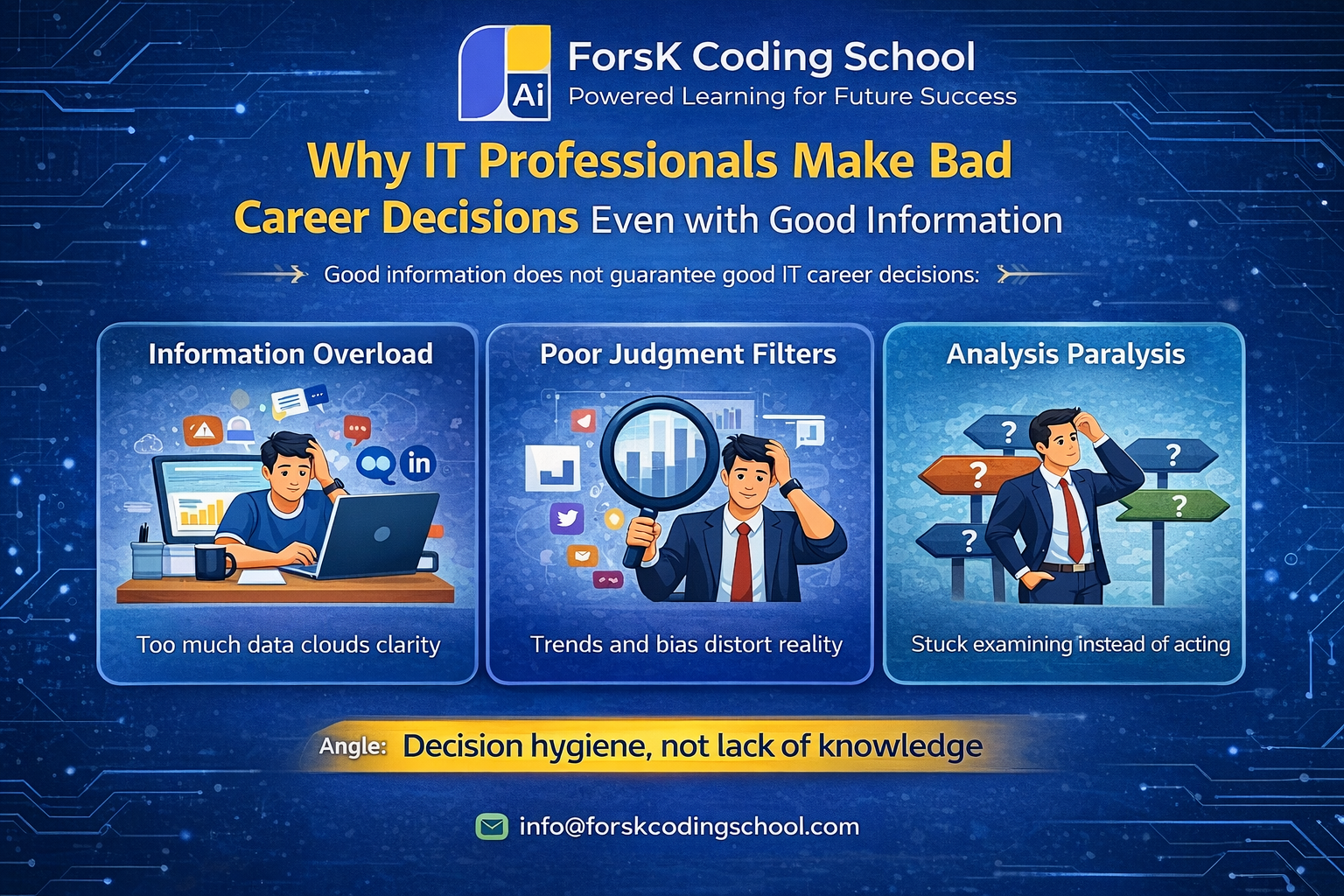
Information Overload Creates False Confidence
When professionals consume large amounts of information, they often feel prepared.
But information volume is not clarity.
Too many inputs can:
- Blur priorities
- Inflate perceived urgency
- Create artificial comparison
More data often increases anxiety—not wisdom.
The Absence of Decision Filters
Information without filtering leads to reactive behavior.
Strong decision-makers use filters such as:
- Does this align with my long-term direction?
- Is this relevant to my current stage?
- What problem am I actually trying to solve?
Without filters, every opportunity feels equally important.
Analysis Paralysis in IT Careers
IT professionals are trained to analyze deeply.
But over-analysis in career decisions creates paralysis.
Symptoms include:
- Endless comparison of technologies
- Waiting for perfect timing
- Seeking one more opinion before acting
At some point, analysis becomes avoidance.
Mistaking Popularity for Suitability
Trends in IT move quickly.
High-paying roles, trending stacks, viral success stories.
Professionals often mistake what is popular for what is suitable.
Suitability depends on:
- Your strengths
- Your tolerance for risk
- Your long-term vision
Popularity ignores context.
Emotional Amplification
Information is rarely neutral.
It triggers:
- Fear of missing out
- Excitement about quick success
- Ego-driven comparison
When emotions mix with data, judgment weakens.
The Real Problem: Poor Decision Hygiene
Decision hygiene means:
- Limiting unnecessary inputs
- Clarifying your own criteria
- Separating emotion from evaluation
- Acting within defined boundaries
Clean decisions require structure—not more information.
Final Thoughts
IT professionals don’t make bad decisions because they lack access to information.
They struggle because they lack structured filtering.
In careers, judgment quality matters more than knowledge quantity.
Information is abundant.
Clarity is disciplined.