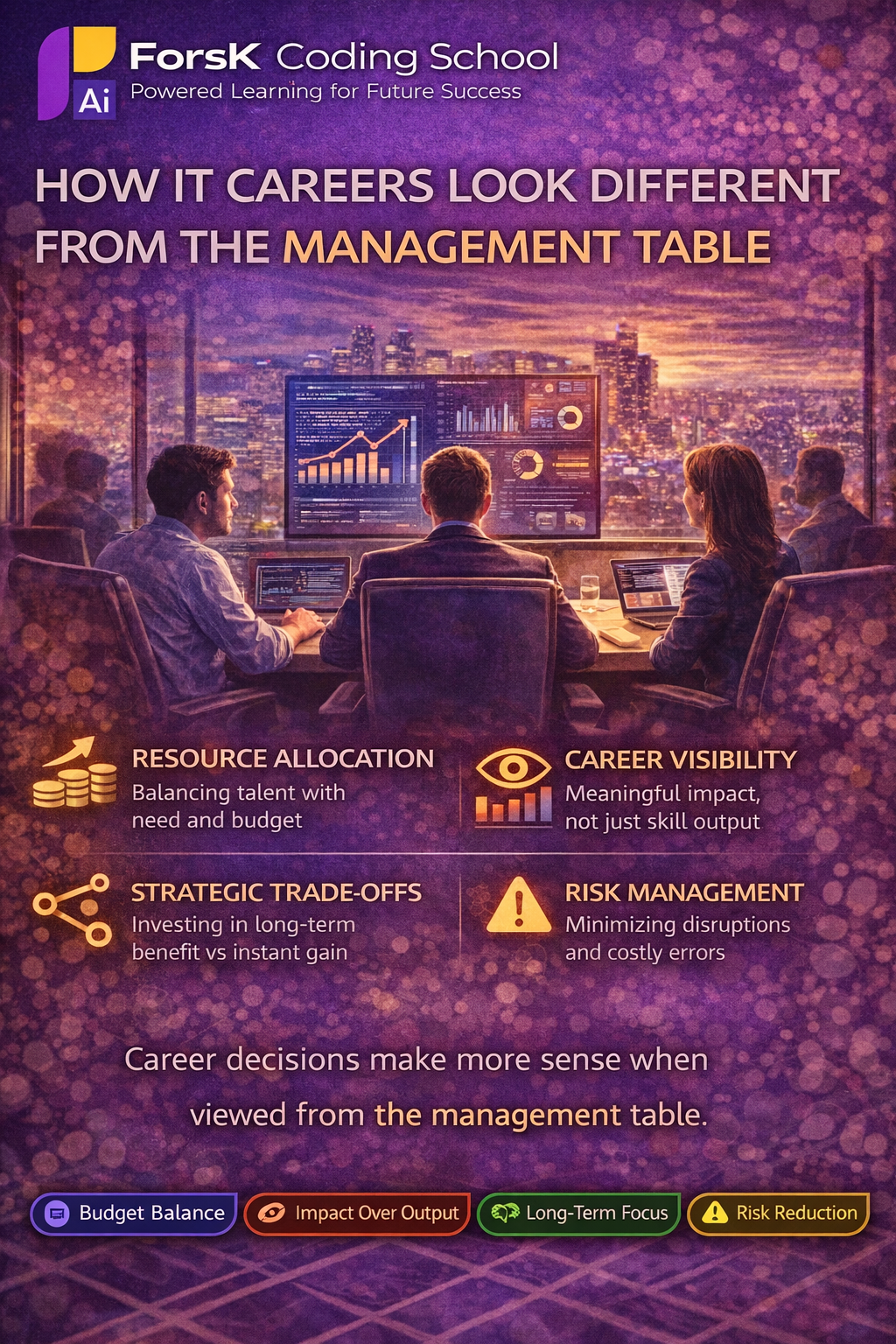
For most IT professionals, career growth is viewed from the execution side—tasks, deadlines, appraisals, and skill upgrades. From the management table, however, careers look very different.
Managers do not see individuals only as coders, testers, or engineers. They see resources, risks, costs, and long-term allocations.
Understanding this perspective explains many decisions that otherwise feel confusing or unfair.
The Management Table Sees the Whole System
While professionals focus on their own role, management looks at:
- Team balance
- Project timelines
- Client commitments
- Budget constraints
- Business risk
Career decisions are made in the context of the entire system—not individual effort alone.
Visibility Is Uneven
From the management table:
- Some work is highly visible
- Some work is critical but invisible
- Some effort does not translate into business value
This is why people who “work very hard” are not always recognized.
Management prioritizes visible business impact.
Resource Allocation Drives Career Outcomes
Managers constantly ask:
- Where should limited talent be placed?
- Who fits which type of problem?
- Who can handle uncertainty?
Career movement often depends on where you fit best, not where you want to go.
Strategic Trade-Offs Are Constant
Every decision involves trade-offs:
- Speed vs quality
- Cost vs capability
- Stability vs experimentation
Sometimes a strong performer is kept in the same role because moving them creates risk elsewhere.
From the employee view, this feels like stagnation.
From management view, it is risk control.
Career Visibility Is Not Equal for Everyone
Not all roles give equal exposure to:
- Clients
- Senior leaders
- Strategic discussions
Visibility often influences growth more than raw performance.
This is a structural reality, not favoritism.
Why Promotions Are Slow and Selective
From management’s side, promotions:
- Increase cost
- Increase risk
- Expand decision authority
They are approved carefully because mistakes at higher levels are expensive.
What Professionals Misinterpret
Common misunderstandings include:
- Assuming effort equals impact
- Assuming skill alone drives growth
- Assuming fairness means equality
Management optimizes for business survival, not emotional fairness.
How to Align With the Management View
Professionals who grow faster:
- Understand business constraints
- Reduce management uncertainty
- Communicate impact clearly
- Think beyond tasks
They make management’s job easier.
Final Thoughts
IT careers look very different from the management table.
What feels slow or unfair from below often makes sense from above.
Professionals who understand this perspective stop fighting the system—and start working with it.
That alignment changes career trajectories.