Many people enter the IT industry chasing salary, job security, or social status. These reasons are valid. But over time, a painful pattern appears.
People start saying:
“I just need to survive this job.”
“I’ll quit once I save enough.”
“I’m tired, but I don’t know what else to do.”
When your career feels like something you must endure rather than something you choose, escape becomes the only dream.
A better goal exists.
Build an IT career you don’t want to escape from.
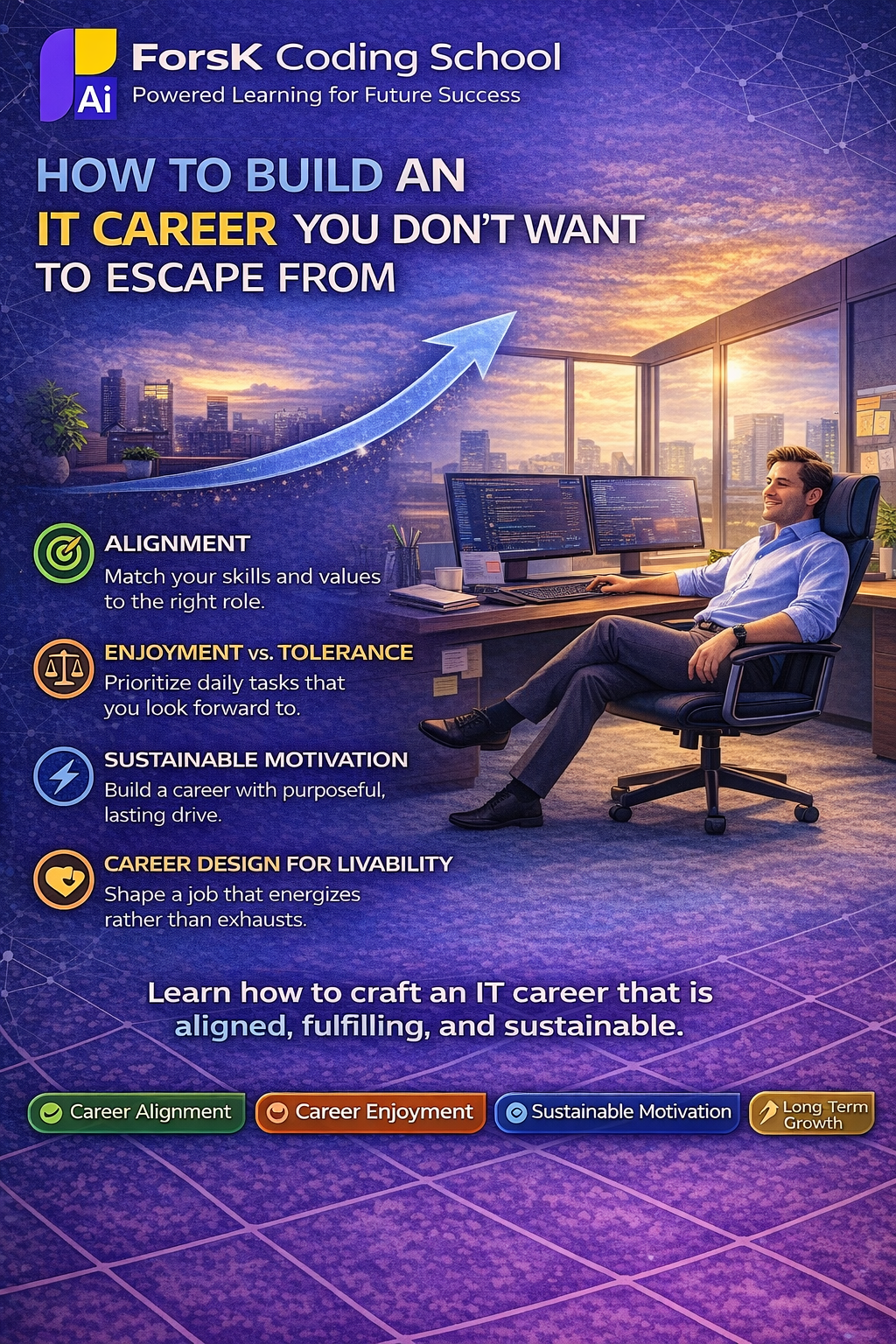
This requires intentional career design focused on alignment, enjoyment, and sustainable motivation.
Alignment: The Foundation of a Livable Career
Alignment means your work fits your natural interests, strengths, and values.
Ask yourself:
- Do I enjoy building things or maintaining systems?
- Do I prefer logic-heavy work or creative problem-solving?
- Do I like deep focus or collaborative environments?
There is no single “best” IT role. The best role is the one aligned with how your mind works.
Examples:
- Some people love backend systems and optimization.
- Some enjoy UI/UX and frontend logic.
- Some prefer data analysis and patterns.
- Some like infrastructure and reliability.
When alignment is present, work feels lighter even when it is challenging.
Enjoyment vs Tolerance
Many professionals confuse tolerance with enjoyment.
Tolerance:
- You can do the work
- You don’t hate it
- You feel drained
Enjoyment:
- You feel curious
- You lose track of time
- You feel satisfied after solving problems
A career built on tolerance leads to slow emotional exhaustion.
A career built on enjoyment fuels long-term growth.
Sustainable Motivation Beats Temporary Inspiration
Motivation based only on money or external pressure fades.
Sustainable motivation comes from:
- Seeing yourself improve
- Solving meaningful problems
- Feeling useful
- Having autonomy
These elements create internal drive.
When motivation is internal, consistency becomes easier.
Design Your Career, Don’t Drift Into It
Many IT professionals let their career happen by accident.
They take whatever role appears first and keep moving without reflection.
Instead, treat your career like a long-term design project.
Questions to revisit regularly:
- What type of problems do I want to solve?
- What kind of day-to-day work do I enjoy?
- What skills do I want to master in the next 3 years?
Small design choices compound into big outcomes.
Build Depth Before Chasing Titles
Chasing titles without depth creates fragile careers.
Depth creates confidence.
Confidence creates options.
Focus on:
- Strong programming fundamentals
- Problem-solving skills
- System thinking
Depth gives you control over your career direction.
Protect Your Energy
A career you enjoy still requires energy.
Ignoring sleep, health, and rest slowly turns even good work into suffering.
Protecting energy is part of career design.
Create a Growth Environment
Your environment shapes your experience.
- Supportive team
- Learning culture
- Reasonable expectations
If your environment is toxic, even aligned work becomes painful.
Sometimes improving your career means changing environment, not profession.
Final Thoughts
An IT career should not feel like a prison sentence.
It should feel like a long journey of building, learning, and growing.
When you design for alignment, choose enjoyment over tolerance, and build sustainable motivation, you create a career you don’t want to escape from.
That is real success.