In IT careers, many professionals believe that faster growth comes from learning advanced topics as early as possible. System design, microservices, AI tools, or advanced frameworks often feel like shortcuts to senior roles. Yet, despite constant learning, many careers hit an invisible ceiling.
The root cause is not lack of effort or ambition. It is weak fundamentals.
This blog explains why strong foundations outperform advanced-topic chasing, how weak basics limit long-term growth, and why compounding fundamentals quietly shape successful IT careers.
The Problem With Weak Foundations
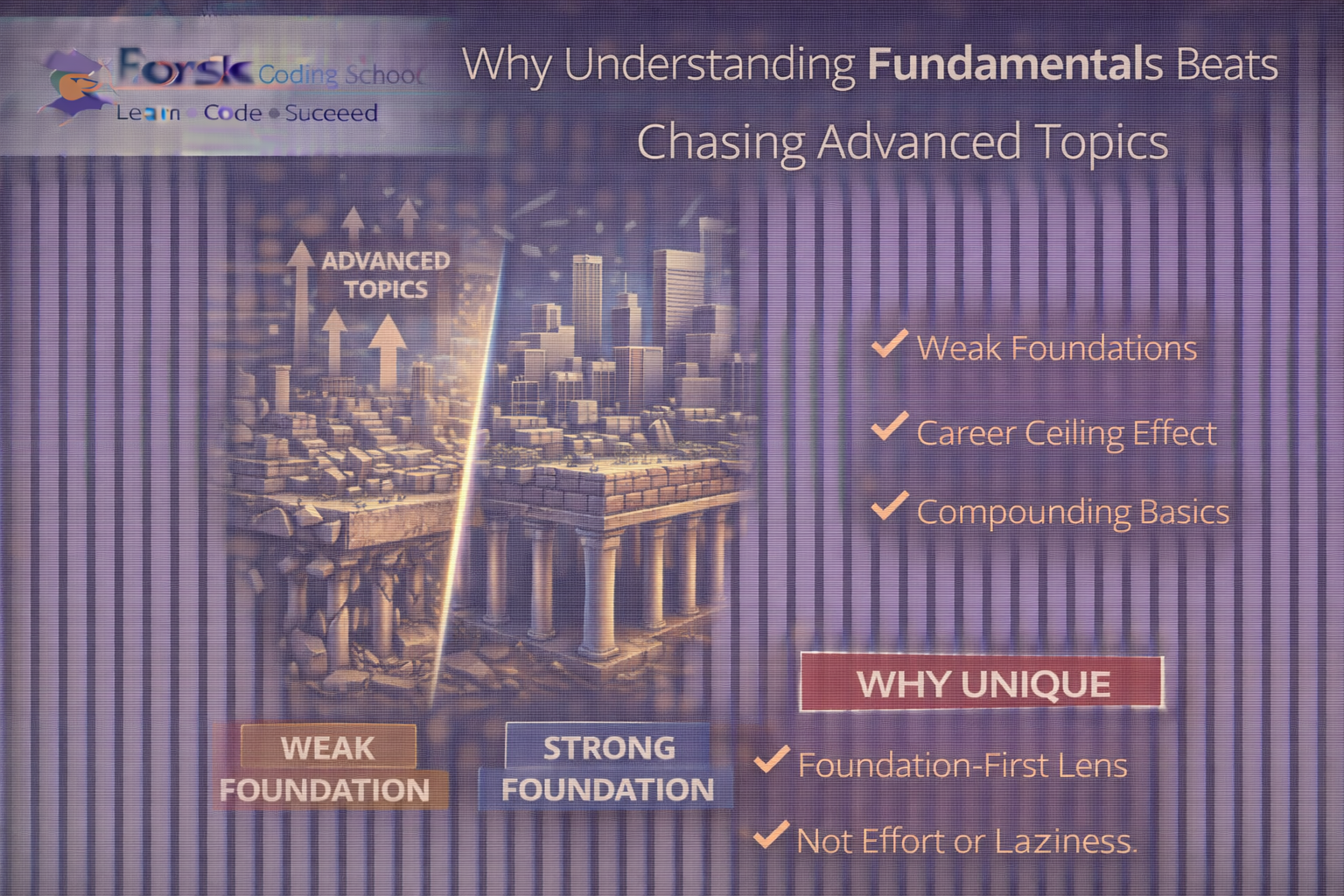
Fundamentals form the base layer of all technical skills. When this layer is unstable, every advanced concept built on top becomes fragile.
Weak foundations often show up as:
- Difficulty debugging unfamiliar problems
- Fear of changing requirements
- Reliance on patterns without understanding
Professionals may know what to use but struggle to explain why it works.
Why Advanced Topics Feel Attractive
Advanced topics give the illusion of progress.
They:
- Sound impressive in resumes
- Create short-term confidence
- Feel closer to senior roles
However, without fundamentals, advanced knowledge becomes shallow. It works only in controlled scenarios and collapses under real-world complexity.
The Career Ceiling Effect
Weak fundamentals create a silent ceiling.
Early in a career, surface knowledge is often enough to deliver tasks. But as responsibility grows, expectations shift toward:
- Problem decomposition
- Decision-making
- System-level thinking
At this stage, professionals without strong basics slow down—not because they lack tools, but because they lack depth.
How Fundamentals Compound Over Time
Fundamentals improve every future skill.
Strong basics help professionals:
- Learn new technologies faster
- Adapt across domains
- Debug efficiently
- Communicate technical decisions clearly
Each concept learned later connects more easily, creating a compounding effect that accelerates long-term growth.
Why This Is Not About Courses or Curriculum
This is not a debate about beginner vs advanced courses.
Fundamentals are thinking habits:
- Understanding data flow
- Knowing execution order
- Grasping trade-offs
- Predicting system behavior
These skills develop through deliberate practice, not certificates.
How to Shift to a Foundation-First Approach
To strengthen fundamentals:
- Revisit core concepts regularly
- Explain basics without jargon
- Build simple systems end-to-end
- Focus on why before how
Depth at the foundation level raises the ceiling of everything built above it.
Final Thoughts
Understanding fundamentals beats chasing advanced topics because careers grow on stable foundations.
Advanced skills change. Tools evolve. But fundamentals compound quietly over decades.
In IT, the strongest professionals are not those who learn the most advanced topics first—but those who never stop strengthening the basics.