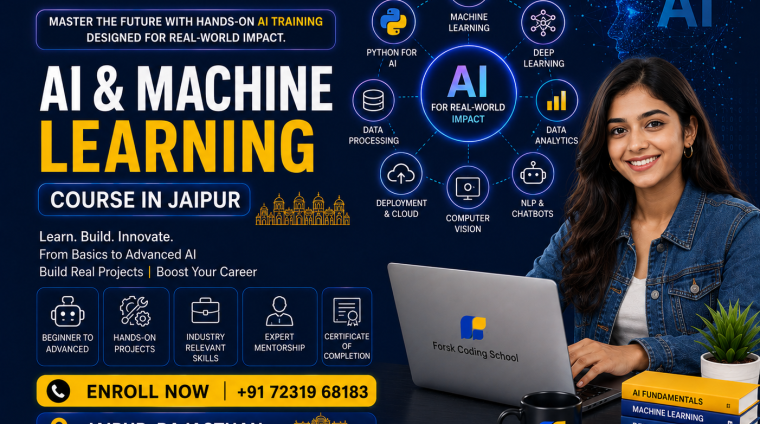
Become an Industry-Ready Artificial Intelligence Professional with Practical AI Training
Master the future with hands-on AI training designed for real-world impact through a complete industry-focused Artificial Intelligence program that helps students, working professionals, startup founders, and technology enthusiasts build practical AI skills for modern enterprise systems.
This advanced Artificial Intelligence training program covers:
- Python Programming for AI
- Machine Learning
- Deep Learning
- Computer Vision
- Natural Language Processing (NLP)
- Generative AI
- Large Language Models (LLMs)
- AI Deployment
- Cloud AI Infrastructure
- MLOps
- Enterprise AI Systems
- AI Startup Development
- Real-World AI Projects
- AI Career Preparation
The course is designed for:
- Students
- Software Developers
- Working Professionals
- Entrepreneurs
- Startup Founders
- Data Analysts
- Full Stack Developers
- Technology Enthusiasts
Whether you want to become a Machine Learning Engineer, Generative AI Developer, MLOps Engineer, AI Researcher, AI Startup Founder, or Enterprise AI Architect, this hands-on AI training program helps you build real-world Artificial Intelligence expertise.
Why Choose This Artificial Intelligence Training Program?
Industry-Focused AI Curriculum
This Artificial Intelligence training program is designed according to modern industry requirements and enterprise AI standards.
Students learn:
- Real-world AI workflows
- Scalable AI deployment systems
- Enterprise AI architecture
- Cloud AI infrastructure
- Production-ready AI development
- Generative AI applications
- AI automation systems
The program focuses on practical implementation instead of only theoretical learning.
Hands-On Artificial Intelligence Training
Students build real-world projects including:
- AI Chatbots
- Recommendation Systems
- AI Automation Platforms
- Computer Vision Applications
- NLP Systems
- Generative AI Applications
- Retrieval-Augmented Generation (RAG) Systems
- AI SaaS Products
- Cloud AI APIs
- Enterprise AI Dashboards
Hands-on training improves practical AI development skills significantly.
Learn from Real Industry Workflows
The course teaches enterprise-level workflows used in modern technology companies.
Students learn:
- Data Collection
- Data Preprocessing
- Feature Engineering
- AI Model Development
- Model Evaluation
- Cloud Deployment
- Monitoring and Optimization
These workflows prepare students for real-world enterprise AI environments.
Complete Artificial Intelligence Course Curriculum
Module 1: Python Programming for Artificial Intelligence
Students learn:
- Python Fundamentals
- Functions and OOP
- File Handling
- APIs and JSON
- Data Structures and Algorithms
- NumPy
- Pandas
- Matplotlib
- Automation with Python
Python is the foundation of modern Artificial Intelligence systems.
Module 2: Mathematics and Statistics for AI
Topics include:
- Linear Algebra
- Probability
- Statistics
- Optimization
- Calculus Basics
- Data Analysis
Mathematics improves Machine Learning and Deep Learning understanding significantly.
Module 3: Machine Learning and Predictive Analytics
Students learn:
- Supervised Learning
- Unsupervised Learning
- Regression
- Classification
- Clustering
- Model Evaluation
- Feature Engineering
- Scikit-learn
- Predictive Analytics
Applications include:
- Fraud Detection
- Recommendation Systems
- Customer Analytics
- Business Intelligence
Module 4: Deep Learning and Neural Networks
Students learn:
- Neural Networks
- CNNs
- RNNs
- Transformers
- TensorFlow
- PyTorch
- GPU Training
- AI Optimization
Applications include:
- Image Recognition
- Speech Recognition
- AI Analytics
- Generative AI Systems
Module 5: Computer Vision and AI Image Processing
Topics include:
- OpenCV
- Object Detection
- Facial Recognition
- OCR Systems
- Medical Imaging
- Real-Time Vision Systems
Students build:
- Smart Surveillance Systems
- AI Camera Applications
- Traffic Detection Platforms
- Image Classification Systems
Module 6: Natural Language Processing and Generative AI
Students learn:
- NLP Fundamentals
- Tokenization
- Embeddings
- Transformers
- LLMs
- Prompt Engineering
- Chatbot Development
- AI Assistants
- RAG Systems
Applications include:
- AI Chatbots
- AI Search Systems
- AI Assistants
- Enterprise AI Automation
Module 7: Cloud Computing, MLOps, and AI Deployment
Students learn:
- Docker
- Kubernetes
- CI/CD
- AI APIs
- AWS
- Azure
- Google Cloud
- Monitoring Systems
- AI Infrastructure Scaling
Students deploy:
- Enterprise AI APIs
- Cloud AI Applications
- Real-Time AI Systems
- Production AI Platforms
Module 8: Enterprise AI Systems and Advanced AI Engineering
Topics include:
- AI Architecture
- Enterprise AI Security
- AI Monitoring
- AI Scalability
- Feature Stores
- Model Versioning
- AI Infrastructure Design
- Distributed Systems
Students build scalable enterprise-grade Artificial Intelligence systems.
Module 9: AI Career Development and Startup Building
Students learn:
- AI Portfolio Development
- Technical Interview Preparation
- Freelancing Opportunities
- AI Startup Development
- SaaS Product Building
- LinkedIn Branding
- Resume Building
- Remote AI Jobs
The course prepares students for global AI career opportunities.
Module 10: Final Capstone Projects and Industry Implementation
Students build final enterprise-level projects including:
- AI SaaS Platforms
- Enterprise AI Systems
- AI Automation Platforms
- AI Analytics Systems
- Generative AI Applications
- Cloud AI Deployment Projects
Capstone projects improve industry readiness significantly.
Real-World AI Projects Included
Students work on practical projects such as:
- AI Chatbot System
- AI Resume Screening Platform
- AI Recommendation Engine
- Healthcare AI Analytics
- Smart Attendance System
- AI OCR System
- AI Voice Assistant
- AI SaaS Dashboard
- AI Customer Support Automation
- Generative AI Search Platform
Projects improve practical Artificial Intelligence development skills.
Tools and Technologies Covered
Programming Languages
- Python
- JavaScript
- SQL
- Bash
AI Libraries
- NumPy
- Pandas
- Scikit-learn
- TensorFlow
- PyTorch
- OpenCV
- Hugging Face
Cloud and Deployment Tools
- Docker
- Kubernetes
- AWS
- Azure
- Google Cloud
- FastAPI
- Flask
Databases
- PostgreSQL
- MongoDB
- Redis
- Vector Databases
MLOps Tools
- MLflow
- DVC
- Prometheus
- Grafana
Benefits of This AI Training Program
Industry-Ready AI Skills
Students learn practical skills used in enterprise technology companies.
Hands-On Project Experience
Real-world projects improve technical confidence and implementation skills.
Career and Placement Preparation
Students receive guidance for:
- AI interviews
- Resume building
- LinkedIn optimization
- Portfolio development
Cloud and Deployment Expertise
Students deploy scalable AI systems using modern cloud infrastructure.
Startup and Freelancing Opportunities
The program helps students build:
- AI startups
- AI SaaS products
- AI automation businesses
- Freelancing careers
Career Opportunities After This AI Course
After completing this Artificial Intelligence training program, students can apply for roles such as:
- Machine Learning Engineer
- Data Scientist
- AI Engineer
- Generative AI Developer
- NLP Engineer
- MLOps Engineer
- AI Research Engineer
- Cloud AI Developer
- AI Architect
- AI Product Developer
Artificial Intelligence professionals are highly in demand globally.
Industries Using Artificial Intelligence
AI technologies are transforming industries including:
- Healthcare
- Finance
- Education
- Cybersecurity
- E-commerce
- Robotics
- Manufacturing
- Logistics
- Cloud Computing
- Enterprise Software
AI skills create global technology opportunities.
Who Can Join This AI Training Program?
This course is suitable for:
- Beginners in AI
- College Students
- Software Developers
- Working Professionals
- Startup Founders
- Freelancers
- Data Analysts
- Full Stack Developers
No advanced AI experience is required to start learning.
Learning Methodology
The program focuses on:
- Practical implementation
- Project-based learning
- Enterprise workflows
- Real-world problem solving
- Cloud deployment
- Continuous learning
Students build scalable AI systems step-by-step.
Why AI is the Future
Artificial Intelligence is transforming:
- Software engineering
- Business automation
- Healthcare systems
- Financial systems
- Enterprise productivity
- Robotics
- Cloud computing
Future AI technologies include:
- AI Agents
- Generative AI
- Robotics
- Edge AI
- Autonomous Systems
- Quantum AI
AI is one of the fastest-growing industries globally.
AI Success Workflow
Complete AI Learning Path
- Learn Programming
- Understand Mathematics
- Study Machine Learning
- Build AI Projects
- Learn Cloud Deployment
- Master MLOps
- Build Enterprise AI Systems
- Create AI Portfolio
- Prepare for AI Careers
- Continue Learning and Innovating
AI Success Formula
Frequently Asked Questions (FAQs)
What is Artificial Intelligence?
Artificial Intelligence is the field of building intelligent systems capable of learning, reasoning, and automation.
Is this AI course suitable for beginners?
Yes, the course starts with Python fundamentals and gradually progresses toward advanced enterprise AI systems.
Which programming language is used in this AI training?
Python is the primary programming language used throughout the course.
Will students build real-world AI projects?
Yes, students work on practical enterprise-level AI projects and deployment systems.
Does the course cover Generative AI?
Yes, the course includes Generative AI, Large Language Models, AI chatbots, Prompt Engineering, and RAG systems.
Is cloud deployment included in the course?
Yes, students learn Docker, Kubernetes, AWS, Azure, Google Cloud, and scalable AI deployment systems.
What career opportunities are available after this AI training?
Students can apply for AI Engineer, Machine Learning Engineer, MLOps Engineer, Data Scientist, and Generative AI Developer roles.
Does the course help with AI interviews and placements?
Yes, the program includes AI interview preparation, portfolio development, resume building, and LinkedIn optimization.
Why Learn Artificial Intelligence in Jaipur?
Jaipur is becoming a growing technology and startup ecosystem with increasing opportunities in:
- Software Development
- Artificial Intelligence
- Cloud Computing
- Data Science
- Startup Innovation
- Enterprise Automation
Students learning AI in Jaipur can access:
- Practical training
- Industry projects
- Startup exposure
- Technology networking opportunities
Artificial Intelligence training in Jaipur creates strong future career opportunities.
Final Conclusion
Master the future with hands-on AI training designed for real-world impact through a complete industry-focused Artificial Intelligence learning program covering Machine Learning, Deep Learning, Generative AI, MLOps, cloud deployment, enterprise AI systems, startup development, and real-world AI implementation.
This practical AI training program helps students and professionals become industry-ready Artificial Intelligence engineers capable of building scalable AI systems, enterprise applications, AI startups, and future technology innovations.
Build the future with Artificial Intelligence and unlock global career opportunities in one of the fastest-growing technology industries.
Curriculum
- 10 Sections
- 97 Lessons
- 10 Weeks
- Introduction to Artificial Intelligence6
- Python Programming for AI13
- 2.1Introduction to Python Programming for Artificial Intelligence
- 2.2Installing Python and Setting Up the Development Environment
- 2.3Python Variables, Data Types, and User Input
- 2.4Python Operators and Expressions
- 2.5Python Conditional Statements and Decision Making
- 2.6Python Loops and Iteration
- 2.7Python Functions and Modular Programming
- 2.8Python Lists, Tuples, Sets, and Dictionaries
- 2.9Python File Handling and Exception Handling
- 2.10Object-Oriented Programming in Python
- 2.11Python NumPy for Artificial Intelligence and Data Science
- 2.12Python Pandas for Artificial Intelligence and Data Analysis
- 2.13Python Matplotlib for Data Visualization and Artificial Intelligence
- Machine Learning Fundamentals20
- 3.1Introduction to Machine Learning and Artificial Intelligence
- 3.2Supervised Learning in Machine Learning
- 3.3Unsupervised Learning in Machine Learning
- 3.4Reinforcement Learning in Machine Learning
- 3.5Data Preprocessing in Machine Learning
- 3.6Linear Regression in Machine Learning
- 3.7Logistic Regression in Machine Learning
- 3.8Decision Tree Algorithm in Machine Learning
- 3.9Random Forest Algorithm in Machine Learning
- 3.10Support Vector Machine (SVM) in Machine Learning
- 3.11K-Nearest Neighbors (KNN) Algorithm in Machine Learning
- 3.12Naive Bayes Algorithm in Machine Learning
- 3.13Model Evaluation Metrics in Machine Learning
- 3.14Overfitting and Underfitting in Machine Learning
- 3.15Feature Engineering in Machine Learning
- 3.16Hyperparameter Tuning in Machine Learning
- 3.17Cross Validation in Machine Learning
- 3.18Bias and Variance in Machine Learning
- 3.19Ensemble Learning and Boosting Algorithms in Machine Learning
- 3.20Machine Learning Project Workflow and Deployment Basics
- Deep Learning and Neural Networks8
- 4.1Introduction to Deep Learning and Neural Networks
- 4.2Activation Functions and Backpropagation in Deep Learning
- 4.3Convolutional Neural Networks (CNN) in Deep Learning
- 4.4Recurrent Neural Networks (RNN) and LSTM in Deep Learning
- 4.5Transfer Learning and Pretrained Models in Deep Learning
- 4.6Natural Language Processing (NLP) in Deep Learning
- 4.7Generative AI and Large Language Models (LLMs)
- 4.8Deep Learning Model Deployment and MLOps
- Computer Vision and AI Applications8
- 5.1Introduction to Computer Vision in Artificial Intelligence
- 5.2Image Processing and OpenCV in Computer Vision
- 5.3Object Detection and YOLO in Computer Vision
- 5.4Face Recognition and Facial Detection in Artificial Intelligence
- 5.5Image Segmentation and Medical Imaging in Artificial Intelligence
- 5.6Real-Time Video Processing and AI Surveillance Systems
- 5.7Augmented Reality (AR) and AI-Powered Vision Systems
- 5.8Optical Character Recognition (OCR) and Document AI Systems
- AI Ethics, Responsible AI, and Future Technologies8
- 6.1Introduction to AI Ethics and Responsible Artificial Intelligence
- 6.2Explainable AI (XAI) and Transparent Machine Learning Systems
- 6.3AI Bias, Fairness, and Responsible Machine Learning
- 6.4AI Security, Privacy, and Cybersecurity in Artificial Intelligence
- 6.5Generative AI, Large Language Models (LLMs) and Future AI Technologies
- 6.6AI Agents, Autonomous Systems, and Intelligent Automation
- 6.7Quantum Computing and Quantum Artificial Intelligence
- 6.8Future of Artificial Intelligence and Emerging AI Career Opportunities
- Real-World AI Projects and Industry Applications15
- 7.1Introduction to Real-World Artificial Intelligence Projects
- 7.2AI Chatbot and Virtual Assistant Project Development
- 7.3AI Recommendation System Project Development
- 7.4AI Fraud Detection and Financial Prediction System Development
- 7.5AI-Powered Healthcare and Medical Diagnosis System Development
- 7.6AI-Based Smart Surveillance and Security System Development
- 7.7AI-Powered Autonomous Vehicle and Smart Transportation System Development
- 7.8AI-Powered E-Commerce and Personalized Marketing System Development
- 7.9AI-Powered Industrial Automation and Smart Manufacturing System Development
- 7.10AI-Powered Agriculture and Smart Farming System Development
- 7.11AI-Powered Education and Smart Learning Platform Development
- 7.12AI-Powered Cybersecurity and Threat Detection System Development
- 7.13AI-Powered Robotics and Intelligent Automation Project Development
- 7.14AI-Powered Generative AI and Large Language Model Application Development
- 7.15Capstone Artificial Intelligence Project and Deployment System
- Advanced AI Deployment, MLOps, and Enterprise AI Engineering10
- 8.1Introduction to MLOps and Enterprise AI Systems
- 8.2Docker and Containerization for Artificial Intelligence Applications
- 8.3Kubernetes and Scalable Cloud Infrastructure for AI Systems
- 8.4CI/CD Pipelines and Automation for Machine Learning Systems
- 8.5Monitoring, Logging, and Observability in Enterprise AI Systems
- 8.6Model Versioning, Feature Stores, and Data Management in MLOps
- 8.7Cloud Platforms for Artificial Intelligence Deployment and Scalable AI Infrastructure
- 8.8Enterprise AI Security, Compliance, and Ethical Artificial Intelligence Systems
- 8.9Large Language Model Deployment and Generative AI Infrastructure Engineering
- 8.10Enterprise Artificial Intelligence Architecture and Scalable AI System Design
- Artificial Intelligence Career Development, Startup Building, and Industry Mastery8
- 9.1Artificial Intelligence Career Roadmap and Industry Opportunities
- 9.2Building a Strong Artificial Intelligence Portfolio and Real-World Project Showcase
- 9.3Artificial Intelligence Interview Preparation and Technical Hiring Process
- 9.4Artificial Intelligence Freelancing, Remote Jobs, and Global Career Opportunities
- 9.5Building Artificial Intelligence Startups and SaaS Product Businesses
- 9.6Future Trends in Artificial Intelligence and Emerging Technology Innovations
- 9.7Building Long-Term Success and Continuous Learning in Artificial Intelligence Careers
- 9.8Final Capstone Projects, Enterprise AI Implementation, and Industry-Ready Artificial Intelligence Systems
- Conclusion, Certification Preparation, and Professional Artificial Intelligence Mastery1