Support Vector Machine (SVM) in Machine Learning
Support Vector Machine (SVM) in Machine Learning
Support Vector Machine (SVM) in Machine Learning is one of the most powerful supervised learning algorithms used in Artificial Intelligence, Data Science, classification systems, and predictive analytics. SVM helps Machine Learning models classify data by finding the optimal boundary that separates categories with maximum margin.
Support Vector Machine (SVM) in Machine Learning is widely used in:
- Face recognition systems
- Image classification
- Email spam detection
- Medical diagnosis
- Text classification
- Fraud detection systems
- AI recommendation systems
- Pattern recognition applications
Understanding Support Vector Machine (SVM) in Machine Learning helps students build strong foundations for Artificial Intelligence, predictive analytics, and advanced classification algorithms.
What is Support Vector Machine?
Support Vector Machine (SVM) is a supervised Machine Learning algorithm used for:
- Classification tasks
- Regression tasks
- Pattern recognition systems
SVM separates datasets using decision boundaries called hyperplanes.
Why Support Vector Machine is Important
Support Vector Machine (SVM) in Machine Learning is important because it helps:
- Build highly accurate classification systems
- Handle high-dimensional datasets
- Improve prediction performance
- Support AI pattern recognition
- Optimize intelligent decision systems
Many Artificial Intelligence applications rely on SVM models for classification tasks.
Example of Support Vector Machine
Suppose a model classifies:
- Spam emails
- Non-spam emails
SVM identifies the best boundary separating:
- Spam category
- Non-spam category
This improves classification accuracy significantly.
What is a Hyperplane in SVM?
A hyperplane is a decision boundary that separates categories in datasets.
Example
For two-dimensional data:
- A hyperplane is a line
For three-dimensional data:
- A hyperplane is a plane
SVM selects the optimal hyperplane with maximum separation.
SVM Hyperplane Equation
w⋅x+b=0w\cdot x+b=0
Where:
- w = Weight vector
- x = Input features
- b = Bias
The equation defines the classification boundary.
What are Support Vectors?
Support vectors are the closest data points to the hyperplane.
They are important because:
- They define the decision boundary
- They influence classification accuracy
- They maximize the margin between classes
SVM performance depends heavily on support vectors.
Margin in Support Vector Machine
Margin is the distance between:
- Hyperplane
- Closest data points
SVM aims to maximize the margin for better generalization.
Margin Formula
Margin=2∣∣w∣∣Margin=\frac{2}{||w||}
Larger margins improve classification reliability.
Types of Support Vector Machine
SVM mainly includes:
- Linear SVM
- Nonlinear SVM
Linear SVM
Linear SVM is used when data can be separated using a straight line or plane.
Applications:
- Spam detection
- Sentiment analysis
- Text classification
Nonlinear SVM
Nonlinear SVM handles complex datasets that cannot be separated linearly.
It uses:
- Kernel functions
to transform data into higher dimensions.
Kernel Functions in SVM
Kernel functions help SVM handle nonlinear datasets.
Popular kernels include:
- Linear Kernel
- Polynomial Kernel
- Radial Basis Function (RBF) Kernel
- Sigmoid Kernel
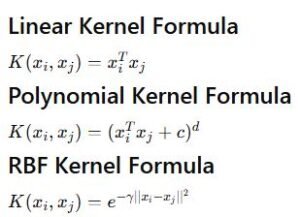
Kernel functions improve SVM flexibility and classification performance.
Support Vector Machine Example in Python
Import SVM Classifier
from sklearn.svm import SVCCreate Model
model = SVC()Train Model
model.fit(X_train, y_train)Predict Values
predictions = model.predict(X_test)Scikit-learn simplifies SVM implementation significantly.
Applications of Support Vector Machine
Support Vector Machine (SVM) in Machine Learning is used in:
- Face recognition systems
- Image classification
- AI recommendation systems
- Medical diagnosis
- Cybersecurity applications
- Fraud detection
- Sentiment analysis
Many Artificial Intelligence systems depend on SVM classification models.
SVM in Artificial Intelligence
Artificial Intelligence systems use SVM for:
- Intelligent classification
- Pattern recognition
- AI prediction systems
- Computer Vision applications
SVM is one of the most powerful Machine Learning algorithms for classification problems.
Advantages of Support Vector Machine
- High classification accuracy
- Effective in high-dimensional spaces
- Works well for small datasets
- Powerful nonlinear classification support
- Strong generalization capability
Disadvantages of Support Vector Machine
- Computationally expensive for large datasets
- Difficult to interpret
- Sensitive to kernel selection
- Requires parameter tuning carefully
Challenges in Support Vector Machine
SVM may face:
- Large computational costs
- Kernel optimization complexity
- Slow training on massive datasets
- Hyperparameter tuning difficulties
AI engineers must optimize SVM models carefully.
SVM vs Logistic Regression
| Logistic Regression | Support Vector Machine |
|---|---|
| Probability-based classification | Margin-based classification |
| Faster on large datasets | More accurate for complex classification |
| Easier interpretation | Better high-dimensional performance |
Both algorithms are important in Artificial Intelligence systems.
Best Practices for Support Vector Machine
- Normalize datasets properly
- Select appropriate kernels carefully
- Tune hyperparameters properly
- Handle imbalanced datasets carefully
- Validate models using testing datasets
- Optimize feature selection
Good practices improve SVM performance significantly.
Future Scope of Support Vector Machine Skills
Support Vector Machine (SVM) in Machine Learning is essential for:
- Artificial Intelligence
- Computer Vision
- Data Science
- Healthcare AI
- Cybersecurity
- Predictive Analytics
- Automation Engineering
Machine Learning Engineers with strong SVM knowledge are highly valuable in modern industries.
Key Takeaways
- SVM is a supervised Machine Learning algorithm used for classification tasks.
- Hyperplanes separate categories in datasets.
- Support vectors define optimal decision boundaries.
- Kernel functions handle nonlinear datasets efficiently.
- SVM powers many Artificial Intelligence classification systems.
Frequently Asked Questions (FAQs)
What is Support Vector Machine in Machine Learning?
Support Vector Machine is a supervised Machine Learning algorithm used for classification and pattern recognition.
What is a hyperplane in SVM?
A hyperplane is a decision boundary used to separate categories in datasets.
What are support vectors?
Support vectors are the closest data points to the decision boundary.
Why are kernel functions important in SVM?
Kernel functions help SVM handle nonlinear datasets efficiently.
Which industries use Support Vector Machine?
Healthcare, cybersecurity, finance, AI analytics, and Computer Vision industries use SVM extensively.